Oct 28, 2026Country Guides
Panama Customs Data (2026): Separate Company Leads From Export Product Evidence
Build a two-track Panama trade audit: import-side exporter names for candidate research and export-side product descriptions for classification checks.
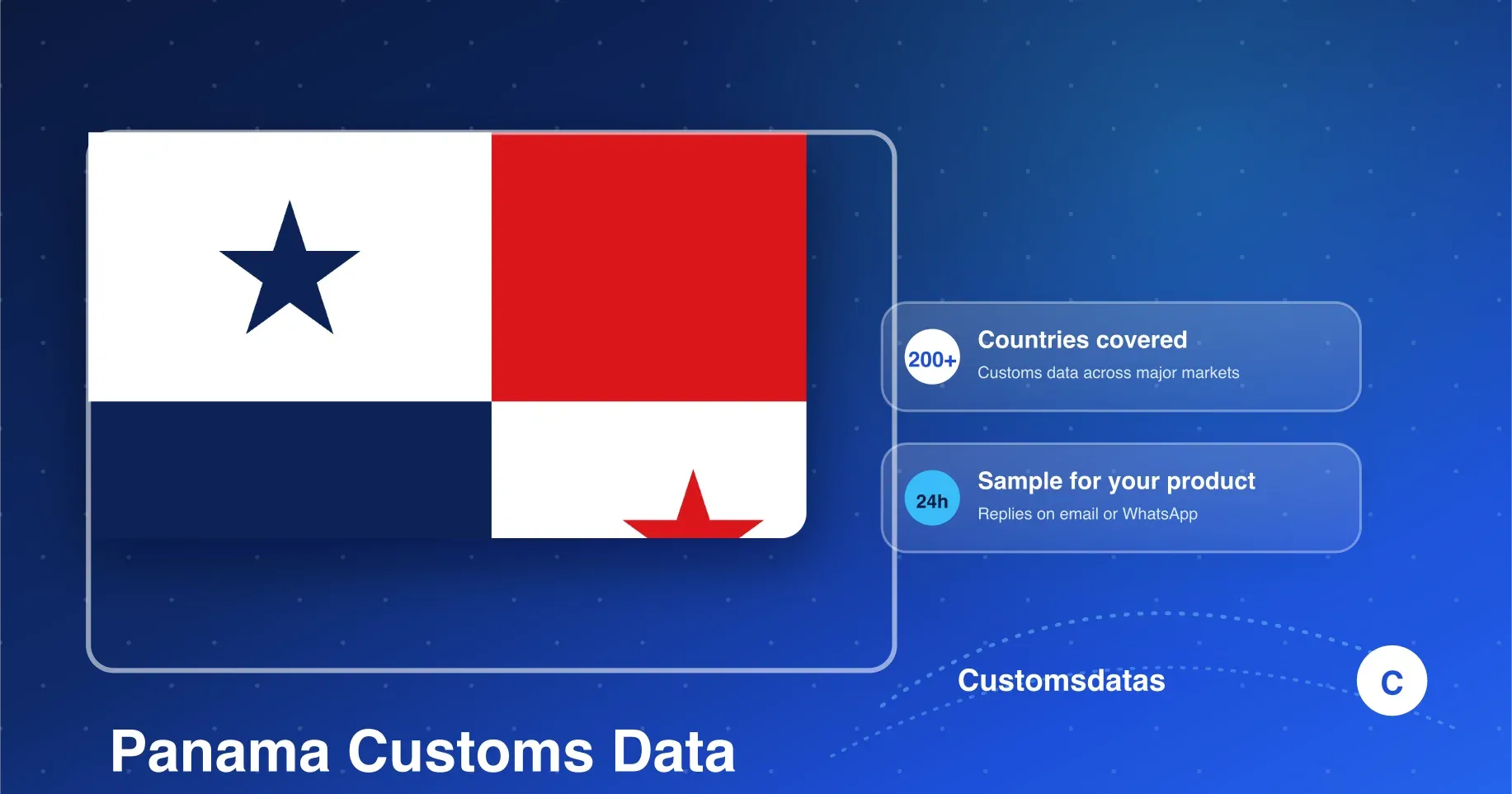
Panama customs data can support company discovery and product research, but the two tasks should not be collapsed into one spreadsheet. The current Customsdatas country matrix identifies trade data for Panama. On the import side, it lists exporter, HS code, quantity, weight, value and brand. On the export side, it lists product description, HS code, quantity, weight, value and brand, without explicitly confirming an exporter-name field. The profile marks Spanish as the language and air coverage and updates as available.
The most important distinction is between a named party and a described product. The fields do not promise both in the same direction. A defensible workflow therefore maintains two tracks, tests representative samples, and documents what cannot be inferred. It should not describe every record as complete or promise a comprehensive list of Panamanian importers or exporters.
Split the Panama audit into two incompatible evidence lanes
Create an import-side candidate sheet and a separate export-side product sheet. Each needs its own direction, date range, HS filters, retrieval date and source notes. The import sheet can investigate exporter names; the export sheet can inspect product descriptions. Do not join them simply because they share an HS code. A classification identifies a category, not a particular transaction or business.
This split also prevents a common reporting error: using a product description from an export row to embellish a company from an unrelated import row. If a combined company-and-product view is required, request a sample that explicitly contains both identifiers before treating the join as evidence.
Run a party-identity screen on Panama’s import side
The confirmed Panama import fields include exporter. That is a useful starting clue, not a verified buyer list. The exporter in an import-direction record may be the party sending goods toward the covered market; the field alone does not identify a domestic end customer or current purchasing decision-maker.
Record the original name exactly, then separately check legal identity, operating website, relevant product catalog and commercial role. Keep name variants visible until the company match is independently supported. A contact found through external research should be labeled as an enrichment, never as a contact supplied by the customs row.
Outbound Panama rows describe goods, not named shippers
The export-direction field list explicitly includes product description, but not exporter. A description can help assess whether a selected HS code includes the intended grade or use case. It does not identify which business exported the item. Resist the temptation to turn a product list into a directory of named Panama exporters.
If supplier identification is the objective, ask whether a representative export sample has a party-name column. Until that is confirmed, frame the output as product-level evidence. This distinction should appear in the methodology note and in any client-facing prospecting deck.
Anchor Spanish search variants to an auditable HS selection
The profile lists Spanish as the record language. Begin with a specific HS code, then test Spanish product terms, common abbreviations and possible alternative descriptions. Preserve the original text beside any English translation. An English-only keyword search can miss relevant terminology or hide ambiguity.
Import-side product description is not in the confirmed field list. A code match there cannot prove a precise model or material. Validate product fit against a company's current catalog or a reliable technical source. For the export side, use actual description samples to record inclusion and exclusion rules.
Audit measurement-unit mismatches before comparing volumes
Quantity and weight are confirmed in both directions. Neither is automatically a standardized unit across every product. Preserve the observed unit, measurement period and classification before calculating rankings. Pieces, packages and mass cannot be compared without a consistent definition.
If a result lacks unit metadata, keep the raw number and flag the limitation. A useful output is a sample-quality table showing how many selected rows have interpretable measurements, not a misleading average shipment size. Do not silently convert weight into item count.
Ask for valuation definitions before interpreting amounts
Value appears on both sides of Panama's field matrix. It may help contextualize a product sample, but the matrix does not establish currency, valuation basis, completeness or current commercial price. A value-per-unit ratio is especially fragile when quantity units or product specifications differ.
Before calculating such a ratio, request the data dictionary and retain the exact period and filters. Label the result as an exploratory data-derived measure. A purchasing team still needs live supplier quotations and terms before treating a number as a sourcing price.
Track trademark strings without assigning distribution rights
Brand is listed for imports and exports. It may distinguish products within a broad classification, but it does not certify that an exporter owns a trademark or is an authorized distributor. Nor does a brand label prove the named party currently stocks that product.
Keep the source brand string and any normalized version in separate fields. Verify claimed relationships against official company material. If the record contains an ambiguous spelling, preserve that uncertainty rather than assigning a confident brand-owner relationship.
Test transport and record recency as independent filters
The Panama profile marks air coverage and updates as available. These are profile-level flags, not guarantees of an air shipment or a particular recent record for every HS code. Request an air-specific example for the target category and inspect its actual mode and dates.
For a repeat analysis, record the newest observed date in each direction separately. If a later extraction differs, check for changes in coverage, classification or filters before declaring a market trend. An update flag is not a real-time delivery promise.
Package the two lanes with an explicit no-join rule
A practical Panama deliverable has an import-side lead-research sheet and an export-side product-validation sheet. Each row should carry direction, HS code, source field, original language, measurement limitations and verification status. Keep inferred company-product links in a separate column with their independent evidence.
This arrangement is less flashy than a single all-purpose directory, but more useful to a sales or procurement reviewer. It makes clear which questions can be answered now, which require a new sample and which depend on external business verification.
Frequently Asked Questions
Does Panama's export field list confirm exporter names?
No. The current export-side matrix lists product description, HS code, quantity, weight, value and brand. Confirm any company-name field in an actual sample before offering an exporter directory.
Can import-side company names be matched to export descriptions by HS code?
Not as proof of a transaction or supplier relationship. A shared classification is not a unique company or shipment identifier. Use a verified common identifier or independent supporting evidence.
Does available air coverage mean recent air records for every product?
No. Air and update flags describe profile availability. Check the chosen code, record dates and actual transport evidence in a sample.
Request a free Panama customs data sample from Customsdatas before building a larger prospect list. Specify the trade direction, HS codes, required company fields and date window, then verify the observed coverage and missing fields before using the results for outreach.