Oct 28, 2026Country Guides
El Salvador Customs Data (2026): Audit Trade and Statistics Without Assuming Fresh Updates
Use El Salvador’s symmetric exporter and product fields while keeping trade rows apart from statistics and acknowledging that updates are not confirmed.
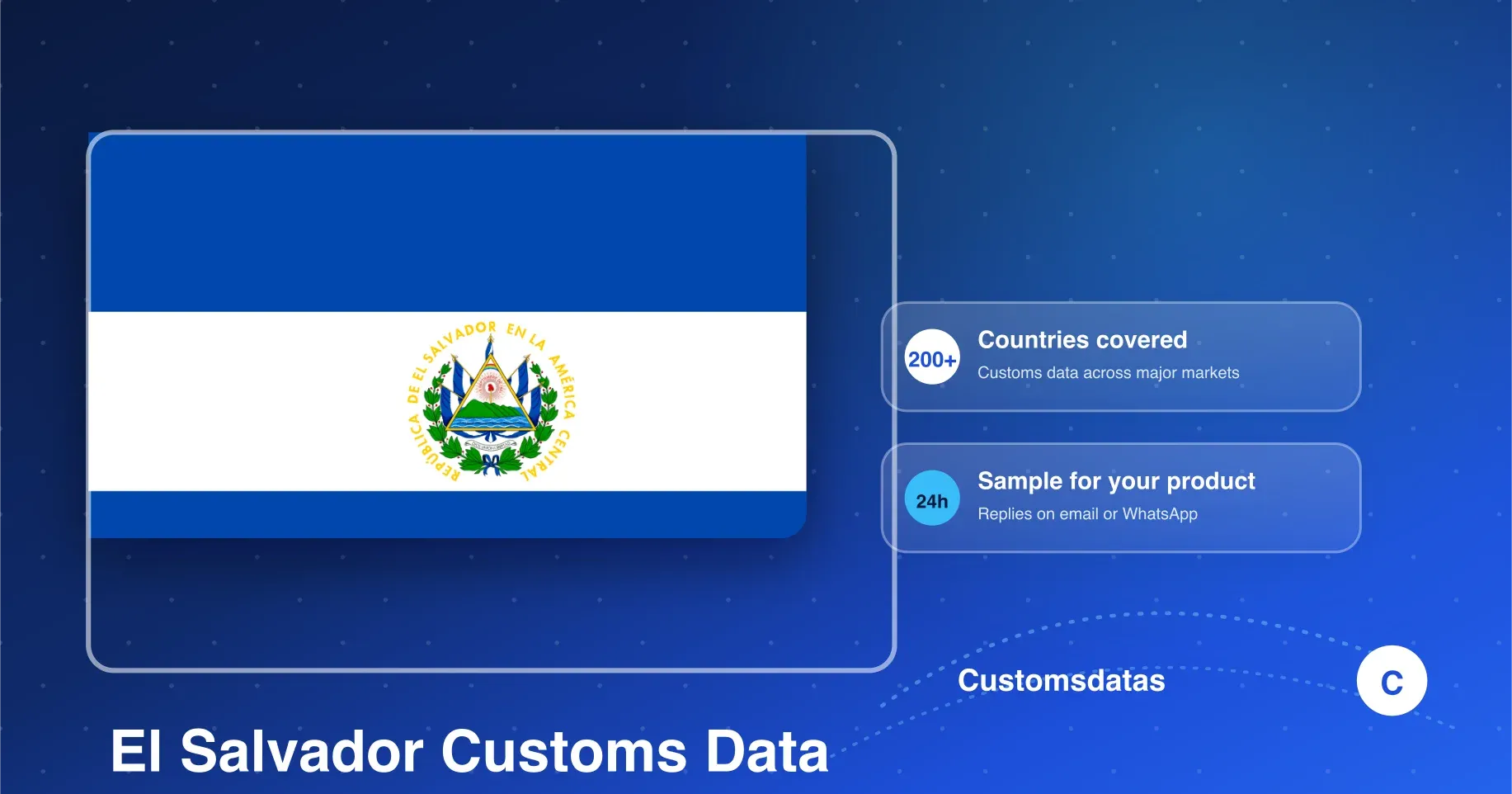
El Salvador customs data presents a useful contrast: the country profile lists both trade and statistics data, yet marks updates as unavailable. Its import and export field lists are symmetrical. Both include exporter, product description, HS code, quantity, weight and value. Brand is not in either confirmed list. The profile marks English as the language and air coverage as available.
These labels define a starting scope, not a guarantee that every requested record exists or that a statistics total can be matched to named companies. The sensible first project is a fixed-period audit: establish which fields appear in samples, distinguish record-level evidence from aggregates and make the absence of a confirmed update capability visible in every output.
Freeze the El Salvador time horizon and label its age
Because the profile marks updates as unavailable, do not present an extraction as live market monitoring. Ask what historical periods are actually covered and preserve the retrieval date separately from the newest record date. An analyst should not infer that a company is actively trading today from an old row.
A fixed observation window also makes comparisons reproducible. Document the HS code, direction, product terms and any exclusions. If two extracts cover different periods, do not interpret their totals as a change in company activity without correcting the scope.
Keep aggregate statistics on a separate reconciliation page
Trade and statistics are both listed for El Salvador, but they answer different questions. A statistics series may describe an aggregate product flow; a trade record may contain a named exporter and transaction-style fields. The matrix does not guarantee identical coverage or reporting rules between them.
Build a separate tab for each data type. Record units, dates, direction and any documented methodology before comparing. A difference between the two is a reconciliation question, not automatic evidence that a company or shipment is missing from the platform.
Measure schema symmetry against actual sample completeness
The six confirmed fields are the same in both directions: exporter, product description, HS code, quantity, weight and value. This makes it possible to design a common field checklist. It does not mean the import and export datasets contain the same businesses, goods or record counts.
Run the same classification and date criteria in both directions, then inspect completeness independently. A field can be present in the schema but blank in selected rows. Report the sample size and observed nulls instead of assuming full population coverage from a country-level label.
Disambiguate cross-border party roles in each dataset
Exporter is listed for both imports and exports. The role attached to that name depends on the direction being viewed. An import-side exporter should not be automatically described as an El Salvador buyer; an export-side name should not be treated as a verified manufacturer.
For each candidate, retain the source spelling and direction, then verify legal identity and present commercial role through independent company information. If the business is an intermediary, that is a qualification finding rather than an error in the underlying trade record.
Make description-to-specification decisions reproducible
Product description is confirmed on both sides. That provides more context than a code alone, but descriptions can still be abbreviated or broad. Start with HS classification and examine actual text for grade, material or application clues. Preserve the original wording and document any translation or normalization.
Do not promise that a description uniquely identifies a model or manufacturer. When a sourcing decision depends on technical suitability, compare the sample text with official product specifications and request confirmation from the supplier.
Mark brand segmentation as unconfirmed in the brief
Neither direction's confirmed field list includes brand. A product description might mention a trademark in an individual example, but that possibility is not equivalent to a documented brand column. Avoid promising brand-specific market shares, authorized distributor lists or comprehensive trademark searches from this matrix.
If brand segmentation is central to the project, request a representative sample and explicitly verify the field before expanding. Keep brand information found through external company research separate from attributes actually present in the customs data.
Treat available air coverage as historical until dates are checked
Air coverage is marked available, while updates are not. These two flags must not be conflated. An air-specific historical sample may be possible, but its availability does not establish a current feed or guarantee that the selected HS code contains air movements.
Ask for the actual record type, dates and transport evidence. If an air subset is empty, state that outcome for the tested query rather than concluding that the product never travels by air. Coverage limitations are not market facts.
Record unit, currency and valuation assumptions per calculation
Quantity, weight and value are listed in both directions. Before aggregating, check quantity units, weight units, currency and valuation definitions. A ratio between declared value and weight is not automatically a product price, especially across mixed goods and reporting periods.
Maintain a small calculation log: original columns, filters, excluded records and unit handling. Where the necessary definitions are missing, show the raw fields and flag the ratio as unsuitable. A cautious result is more credible than false precision.
Hand off a historical evidence pack, not a live lead feed
A useful El Salvador report includes three distinct outputs: a fixed-period trade ledger, a separate statistics summary and an externally verified company shortlist. Each has its own evidence standard. A named exporter is a lead for research, not proof of purchasing intent or an available contact person.
Before outreach, verify the company's current website, products and role. Record which facts come from the sample and which are later enrichment. That discipline matters especially when the profile does not confirm ongoing updates.
Frequently Asked Questions
Are exporter and product description confirmed for both directions?
Yes. The current matrix lists exporter, product description, HS code, quantity, weight and value for imports and exports. Verify population and field completeness in the actual sample.
Can El Salvador customs data be described as continuously updated?
Not from the current profile. Its update flag is unavailable. Confirm the latest observed dates and avoid claims of live or monthly refreshes without new evidence.
Can trade rows and statistics be summed into one company ranking?
No. They may have different scopes and measurement rules. Keep them separate until compatible definitions and periods have been verified.
Request a free El Salvador sample from Customsdatas with a specified HS code, direction and historical period. Confirm trade-versus-statistics scope, field completeness and latest observed dates before using it for supplier research or market reporting.