Country Guides
Malawi Customs Data (2026): Build an Evidence Trail Sales Can Replay
A claim-to-source mapping method for using Malawi trade-data signals while keeping product relevance, entity identity, and commercial conclusions separate.
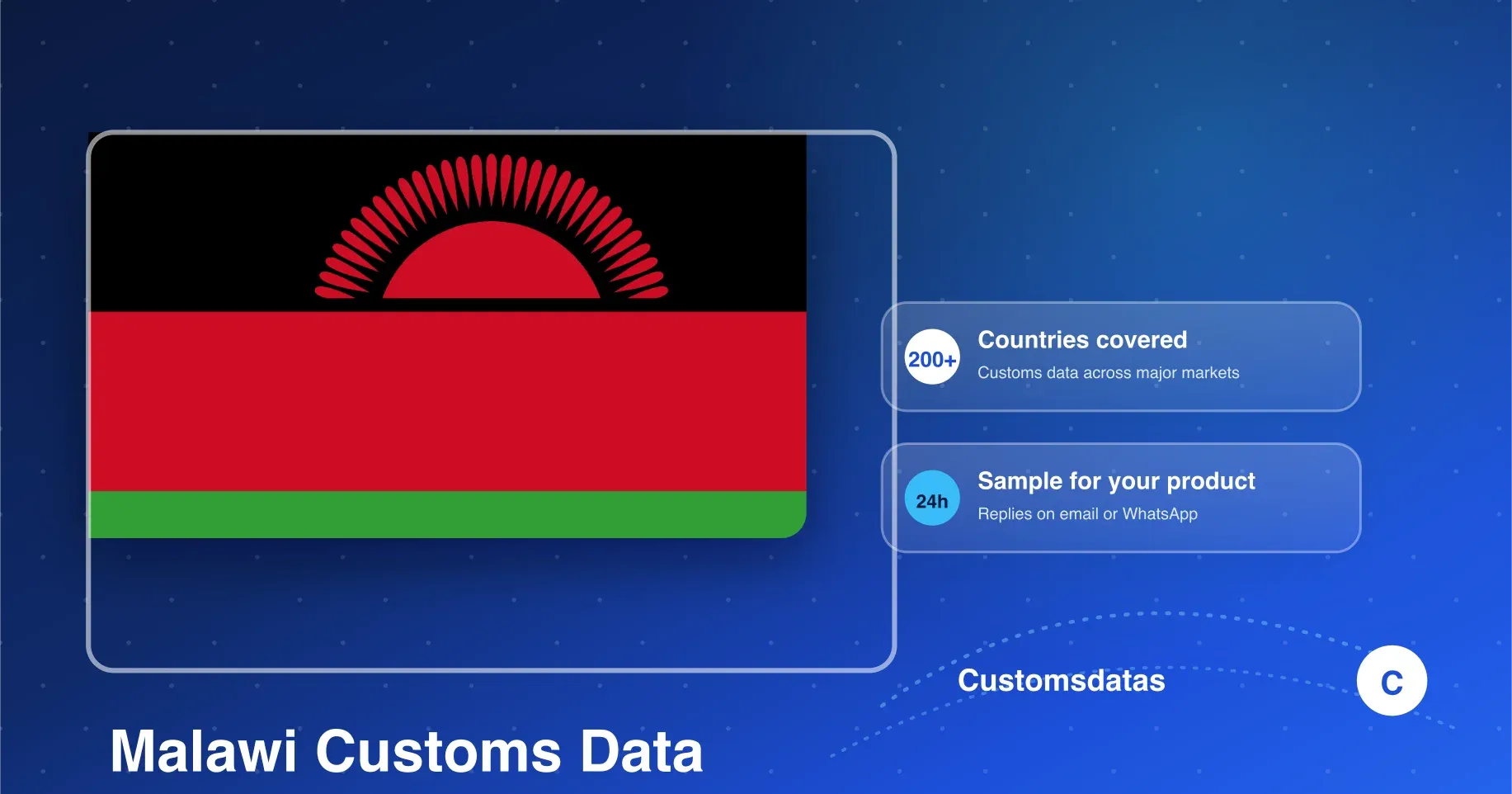
If that sounds familiar, picture a sales team receiving a spreadsheet and asking which names are ready for outreach. The useful answer begins with a traceable chain of claims, not a guessed ranking. The Customsdatas country queue identifies a trade-data category for Malawi. It does not provide country-specific field detail, so a researcher should not assume that a sample contains named companies, particular identifiers, or a complete view of trade activity. The practical challenge is to keep each conclusion connected to the observation and transformation that produced it, especially when a research note will later be used by a sales team.
This guide uses a claim-to-source map rather than a ranked list. Each commercial statement is broken into smaller claims, each claim receives a source receipt, and each transformation is recorded so another analyst can replay or challenge it. The map is useful precisely because it allows a team to leave a claim unresolved instead of filling the gap with a confident guess.
This proof graph keeps each statement accountable
Start by writing the conclusion the team hopes to reach, then break it into statements that can be checked independently. A product may be relevant to a market; an observation may be present in a sample; an organization may be correctly identified; and a contact may have authority. Those are separate claims. Do not put them into one “lead score.” For Malawi, the queue supports only the fact that a trade-data category is available for research. Every more specific statement must be verified from the actual sample or an independent source.
Break a conclusion into independent checks
Turn a sentence such as “this is a promising buyer” into smaller questions: what observation was retrieved, what product meaning was assigned, what organization was matched, and what makes the organization commercially relevant? Give each question a status of confirmed, rejected, or unresolved. A claim should not inherit the status of a neighboring claim. For example, a valid observation does not automatically confirm the entity match. This structure makes the research more honest and helps reviewers identify exactly where the reasoning needs additional evidence.
Log retrieval context at the moment of capture
For each step, save the query text, retrieval time, source context, and any transformation applied to the observation. If a product description is normalized, preserve the original wording beside the normalized form. If two labels are joined, record the join rule and the reason it is defensible. If no transformation occurred, say so. The receipt should be sufficient for another analyst to reconstruct the result without relying on memory. This is especially important when a brief moves between research, marketing, and sales, as each team may otherwise interpret the same label differently.
So product relevance never authenticates a company name
Create one branch for the product question and another for the organization question. The product branch asks whether the observation fits the defined item. The entity branch asks whether a named organization can be independently identified and whether its activities support the proposed relationship. Do not let a strong product match compensate for a weak company match. Equally, a recognizable organization should not make an unrelated product observation appear relevant. Separate branches make the evidence gap visible and prevent an attractive candidate from receiving a false sense of certainty.
Mark incomplete observations without filling the gap
Every map needs an explicit place for missing fields, unclear definitions, incomplete requests, and contradictory observations. Record the exception, its impact, and the smallest piece of evidence that could resolve it. Do not silently remove awkward rows or replace an unknown value with zero. A missing observation, a failed retrieval, and a confirmed zero are different states. When the sample cannot distinguish them, keep the claim unresolved and describe the limitation in plain language. This gives the next analyst a useful task rather than a misleadingly clean dataset.
Try to break the explanation with a rival account
Choose one alternative explanation for the result and ask what evidence would make it more plausible. A product match may reflect a broad category rather than the exact item; a party label may refer to an intermediary; or a company-name match may join two different entities. The competing explanation should be concrete enough to test. If the original conclusion survives, record why. If it does not, revise the claim status and preserve the earlier version. The purpose is to expose weak reasoning before it becomes a sales promise.
Track which conclusions depend on a definition
A claim-to-source map should show which conclusions depend on a particular field meaning, product boundary, date window, or identity match. If any of those inputs changes, the analyst can identify which downstream statements need to be revisited. Keep the original source receipt and the revised receipt together; do not overwrite the first observation. This version discipline is not a claim that Malawi data is revised on a particular schedule. It is a general control for any research workflow where definitions or source scope may later be clarified.
Make the handoff readable without the original analyst
The sales handoff should contain only the claims that passed their own proof checks, plus a short list of open questions. Show the original observation, the product interpretation, the entity evidence, and the remaining limitation as separate items. A sales colleague should be able to explain why a candidate is being contacted without claiming that the trade source established more than it did. If the identity branch is unresolved, the candidate should remain a research task, not an approved outreach target.
This release rule favors traceability over volume
A useful release rule is simple: no claim enters an external message unless its source receipt and reasoning path can be reviewed. The team may still prioritize research when evidence is incomplete, while it should label the work as a hypothesis and avoid presenting it as a confirmed transaction or buyer relationship. This rule can reduce the number of names released in the short term while improving the quality of each handoff. The map is successful when it makes both the supported conclusion and the unresolved boundary easy to see.
Frequently Asked Questions
FAQ: Does Malawi trade data expose every source field?
No such guarantee is established by the queue. Check the current sample and record the actual field names, definitions, and gaps before relying on them.
FAQ: Why keep product and company claims separate?
A product observation can be valid while the organization match is wrong. Separate claim branches prevent one strong result from masking a different unresolved question.
FAQ: What should a reviewer receive with a lead hypothesis?
Provide the original query, source receipt, product interpretation, entity evidence, exception notes, and the exact reason the candidate is ready for the next step.
Explore Customsdatas. Message us through the Contact Us page to request a Malawi sample with a source-scoped field inventory before turning a trade signal into a prospecting claim.