Oct 26, 2026Country Guides
Chile Customs Data (2026): Separate Company Discovery From Trade Statistics
Use Chile import-side exporter names carefully while keeping product descriptions, value and statistics views distinct across trade directions.
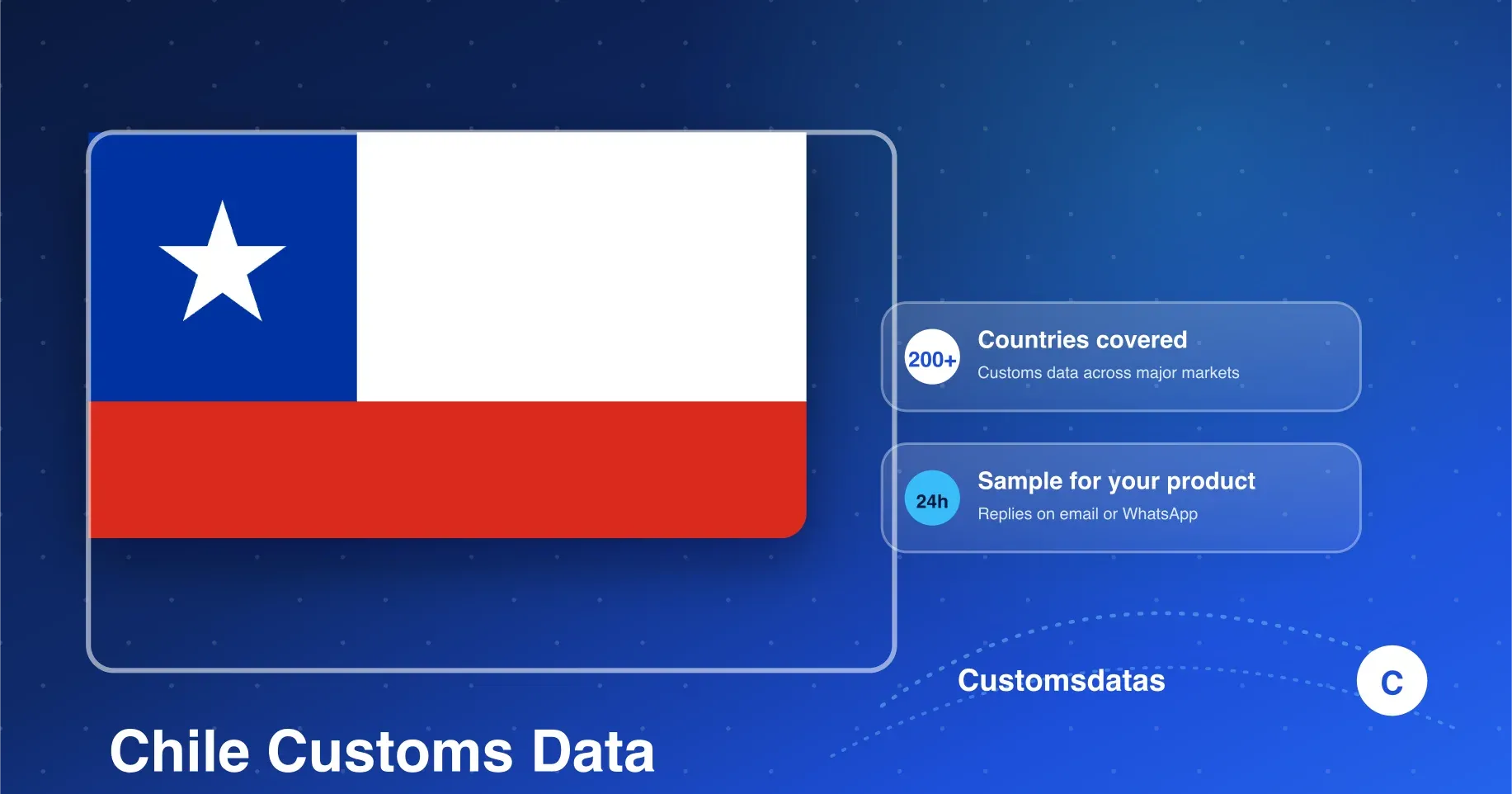
Chile customs data invites two kinds of research: identifying companies linked to product classifications and understanding the movement of product categories over time. These are related but different jobs. The current Customsdatas country matrix lists trade and statistics data types. On the import side, it confirms exporter, HS code, quantity, weight, value and brand. On the export side, it lists product description, HS code, quantity, weight, value and brand, but does not explicitly confirm exporter names. The profile marks Spanish records, air coverage and updates as available.
These are coverage labels, not assurances that every requested field appears in every returned record. Before drawing conclusions about a supplier, product or time period, build a sample around one question and inspect the actual columns. The following method helps keep company discovery separate from product-flow analysis.
Decide which direction can answer your company question
The import-side field list includes exporter. It can therefore provide a starting point for checking which named companies appear in the available Chile-related import records for a particular HS classification. An exporter name is not automatically a Chilean buyer, an end customer or a verified manufacturing site. It is a party label requiring context and independent company research.
The export-side list is different: product description appears, but exporter is not explicitly listed. Do not promise a named list of Chilean exporting companies from that field matrix alone. If a supplier directory is the actual goal, ask for a representative export-side sample before assuming a party-name field is available.
Keep statistics separate from transaction-style evidence
The Chile profile includes statistics as well as trade data. An aggregate statistical total for a product code may represent a different level of measurement than an individual trade row or company entry. Summing importer-side quantities and comparing them directly with national totals without checking the method can produce apparent gaps that are artifacts of coverage.
Ask what each source type measures, which reporting calendar it follows and whether values use the same currency and valuation rule. A defensible report can show both views side by side with separate labels. It should not silently merge them into one seemingly complete customs database.
Classify products using the original Spanish terminology
The current profile shows Spanish as the record language. Search terms written only in English can overlook common commercial descriptions, abbreviations or regional wording. Start with the relevant HS classification, then test Spanish-language variants for the intended product and record why each was included.
The import-side matrix does not explicitly confirm a product-description column, while the export side does. For import-side named-company research, a matching code alone should not be presented as proof of an exact product specification. Validate the candidate through its current official catalog or another credible independent source.
Use quantity and weight only after unit checks
Both directions list quantity and weight. They can be valuable measurements, but they should not be treated as interchangeable. A count of pieces does not mean the same thing as kilograms, and the apparent size of a shipment changes with packaging, product density and unit conventions.
For any ranking, preserve the original value, its observed unit, the code and the date window. Compare only entries with compatible product definitions and measurement units. If a unit is missing, label the record uncertain rather than creating an estimated quantity. This is particularly important when a sales team interprets rankings as evidence of demand.
Report declared value without calling it an invoice price
Value is included in the import and export field lists. That does not establish currency, valuation basis, tax treatment or a sale price for a specific item. A derived value-per-unit measure can be misleading when the weight, quantity or included charges are inconsistent.
Before using value in a market graphic, ask for the underlying currency, field definition and covered period. Keep the calculation reproducible and describe it as a data-derived ratio, not a current purchasing quotation. Product mix and reporting practices can explain differences that do not reflect commercial price changes.
Use brand to narrow a shortlist, not prove authorization
Brand is a confirmed field in both directions. It can help an analyst distinguish product families or examine whether the result resembles the intended category. But a brand label in a trade row does not mean the party named elsewhere owns the trademark, has exclusive rights or can supply that brand to a new buyer.
Cross-check the brand and product against official company information. Where labels are abbreviated or spelled differently, keep the original source value and the normalized interpretation separately. Do not enrich a record with speculative distributor status merely to complete a CRM column.
Treat air coverage and updates as sample questions
Air coverage and updates are marked available for Chile. That is a reason to ask for relevant records, not a guarantee that the chosen HS code has air movement or that the latest data are from the current month. The actual record type and the last visible date must be inspected.
When comparing exports across two periods, keep the HS selection, language terms and data-type filters constant. Differences in a new extraction may reflect coverage expansion or updated classification mappings rather than genuine growth in trade. An update log can distinguish a change in data from a change in the market.
Move from evidence to verified outreach
A company name found in the import-side sample belongs in a prospecting ledger, not immediately in a qualified-lead list. Check the legal business, official website, current product line and commercial role. The company may be an intermediary rather than an end user. Keep your own inference separate from facts shown in the underlying record.
For Chile, one useful deliverable is a company-research sheet built from the import-side name and code fields; a separate product-flow analysis can use export-side descriptions and measures. Mixing these into a single table can hide uncertainty and produce misleading supplier claims. Request a free Customsdatas sample before expanding either project.
Frequently Asked Questions
Does Chile's export-side field list confirm named exporters?
Not in the current profile. It lists product description, HS code, quantity, weight, value and brand for the export side. Confirm any exporter-name column directly in a sample.
Can I compare Chile statistical totals with named company records?
Only if the scopes, units, periods and reporting definitions are compatible. Trade and statistics are separate data types in the profile; they should not be assumed to reconcile automatically.
Do available air coverage and updates prove a fresh air-shipment record exists?
No. Those are profile-level capabilities. Inspect the record type, actual dates and product-specific results before drawing such a conclusion.
To investigate a Chilean product segment without overclaiming the source, request a free sample from Customsdatas. Confirm the direction, field population, covered period and data type before using the results in procurement or outreach.