Country Guides
Central African Republic Customs Data (2026): Make Sparse Searches Explain Themselves
A negative-result evidence ledger that keeps sparse Central African Republic searches separate from unsupported market conclusions.
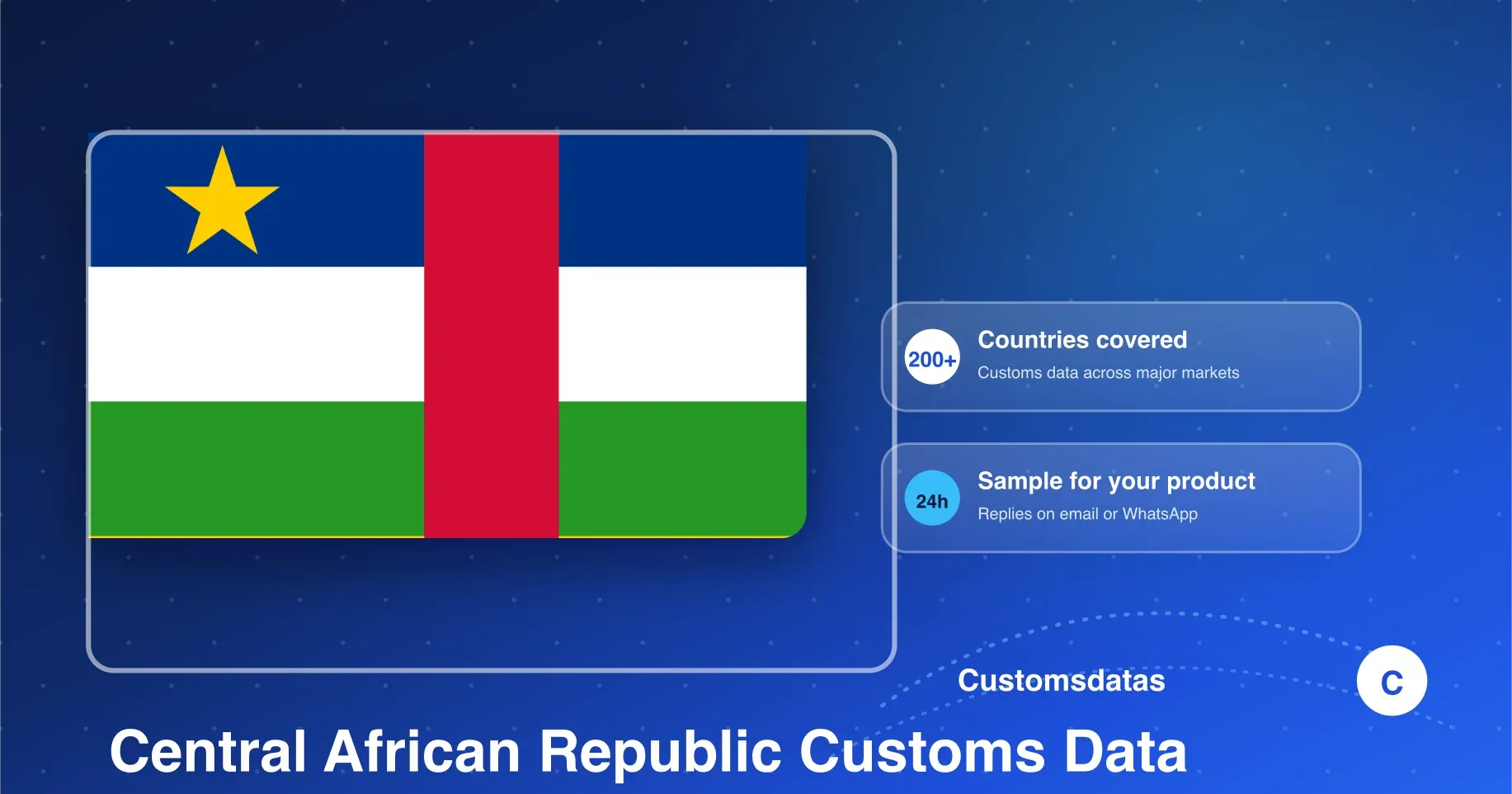
Research into Central African Republic customs data can start with a narrow product question and end with very little visible evidence. That outcome is easy to overinterpret. A blank result panel might reflect the query, the selected period, an access boundary, an unsupported term, or genuinely absent observations in the tested subset. It does not by itself establish a national market fact. The Customsdatas source inventory confirms a trade-data category for Central African Republic, but provides no independently verified country-specific field schema, completeness figure, trade amount, or company roster.
This guide turns an inconclusive search into an auditable research memo. Rather than decorating a sparse result with speculative totals, it asks which explanation remains plausible, what would distinguish explanations, and when a second source is worth consulting. Its central artifact is a negative-result ledger: a record of exactly what was tested and what the test cannot prove.
Frame the Empty-Result Question Precisely
State the product concept and the exact business decision before collecting anything. For example, the decision may be whether to fund a further product-category investigation, not whether Central African Republic has no buyers. Specify whether the experiment concerns a name, a product family, or a classification hypothesis. Treat all of those as analyst-defined targets until sample evidence is available. Capture the date, language of the query, filters, time window, and search interface. A colleague should know the difference between no visible records for one query and evidence that a whole market is absent.
Pair Each Target Search with a Positive Control
A negative test is hard to interpret unless the researcher knows the interface was capable of returning something under comparable conditions. Design a harmless positive control that tests basic functionality without assuming any particular Central African Republic company exists. The control may use a documented test fixture, an interface example, or a separately verified known query if access allows. Record control behavior and limitations. If the control fails too, classify the session as technically inconclusive rather than reporting a country result. Never treat sample demonstration content as proof of live national coverage.
Preserve Query Mutations as Separate Trials
Do not silently widen a search until something appears. Store each changed spelling, product synonym, classification candidate, date range, or filter set as its own trial with a reason for the change. If the system exposes such filters, document their actual names after inspecting the screen; the supplied country inventory does not guarantee them. Keep the original query alongside the widened query so a later analyst can see whether added results came from a different definition. A result obtained after broadening cannot be retroactively described as a precise match to the first narrow target.
Assign an Explanation Code to Every Sparse Outcome
Use a short set of internal outcome codes: no visible matches, controls unavailable, uncertain terminology, access or interface limitation, and sample requiring independent validation. These are project labels rather than official platform statuses. Add one sentence identifying the evidence for each code. The classification matters because the correct next action differs. Uncertain vocabulary calls for a terminology review; missing controls call for a technical check; unverified samples call for a source comparison. None licenses a statement about total Central African Republic trade activity.
Partition Unseen Data from an Explicit Numeric Zero
A field that is not displayed is not a numeric zero. A query yielding no rows is not the same as a period with a measured zero value. A blank company label is not proof that the trading party does not exist. On any returned sample, record the fields actually offered, which values are missing, and whether definitions can be inspected. Only then decide which comparisons are possible. If the product cannot reveal the relevant field for this country view, preserve that limitation in the report rather than borrowing a schema from another country article.
Test Alternative Product Language Without Presuming Coverage
Product descriptions may be phrased differently by data providers, counterparties, or researchers. Make a vocabulary worksheet with the original commercial term, a neutral alternative, and a reason each alternative may be broader or narrower. Test variants separately if the interface supports them. Avoid assuming a particular language, tariff code, company role, or transport mode is available for Central African Republic. Any candidate classification should be confirmed against an appropriate external definition before analysis. A broader match is a lead for inspection, not a verified product count.
Reconcile a Second Source as an Independent Witness
If a decision warrants more work, consult a separate public document, a customer-supplied invoice, or another appropriately licensed source that can test the narrow hypothesis. Write down its purpose and date before looking at it. Agreement between sources can strengthen a specific assertion, but it does not certify comprehensive coverage. Disagreement should be logged with plausible causes: differing definitions, time windows, or entity identities. Do not combine records as though they were a single comparable series without first resolving these boundaries.
Route Sparse-Outcome Codes to Distinct Follow-Up Tests
The final memo needs three columns in prose: what was observed, what remains unverified, and what test could change the decision. Keep the original screenshots or query receipts as supporting evidence where permitted. A responsible outcome can be to request one illustrative Central African Republic sample, refine a product taxonomy, or pause the research until a field definition is confirmed. State the budget and owner of any next test. Leave national growth claims, ranked buyer lists, and completeness assertions out of the memo unless separately evidenced.
Frequently Asked Questions
FAQ: Does a blank Central African Republic result mean there are no importers?
No. It establishes only that a specific search returned no visible matches under recorded conditions. Coverage, access, vocabulary, period choices, and the interface may affect that observation. A national absence claim would require much stronger, independently suitable evidence than a single search.
FAQ: Which columns can I expect in Central African Republic customs data?
The verified inventory identifies a trade-data category but does not confirm an exact column list for this country. Request and inspect a representative sample before claiming company identities, product descriptions, amounts, shipment details, or trade directions. Document the tested schema and any missing definitions.
FAQ: How can sparse evidence still support a business decision?
Use it to decide whether a clearly defined verification experiment is worth funding. A documented limitation can prevent wasted outreach or unsupported market claims. The memo should specify the test, effort cap, and evidence threshold; if those conditions cannot be met, it should recommend pausing rather than inventing certainty.
Explore Central African Republic customs data on Customsdatas by requesting a narrowly defined sample assessment. Share your product vocabulary and intended decision, then ask which fields and observations can actually be verified before acting on a sparse search or an assumed market opportunity.