Oct 17, 2026Guides
What AI Can and Cannot Do in a Sourcing Campaign
AI is strong at some steps of a sourcing campaign, an assistant at others, and a poor fit for the one that decides the outcome. Mapping the steps honestly turns tools into a workflow.
AI tools for export sourcing now come up across trade discussions, and the conversation tends to split into two camps: it changes everything, or it is a gimmick. Both camps are arguing about a single thing called AI; the useful move is to stop treating it as one thing and map it against the steps a sourcing campaign actually has. Some steps reward automation heavily, some barely at all, and a workflow built on that distinction is what separates a real gain from a subscription nobody opens.
This guide walks the campaign step by step with one question at each: what does AI genuinely do well here, and what remains irreducibly human. The boundary is the content — knowing it is what lets a buyer of these tools ask the right questions.
Step one: finding candidates (AI is strong)
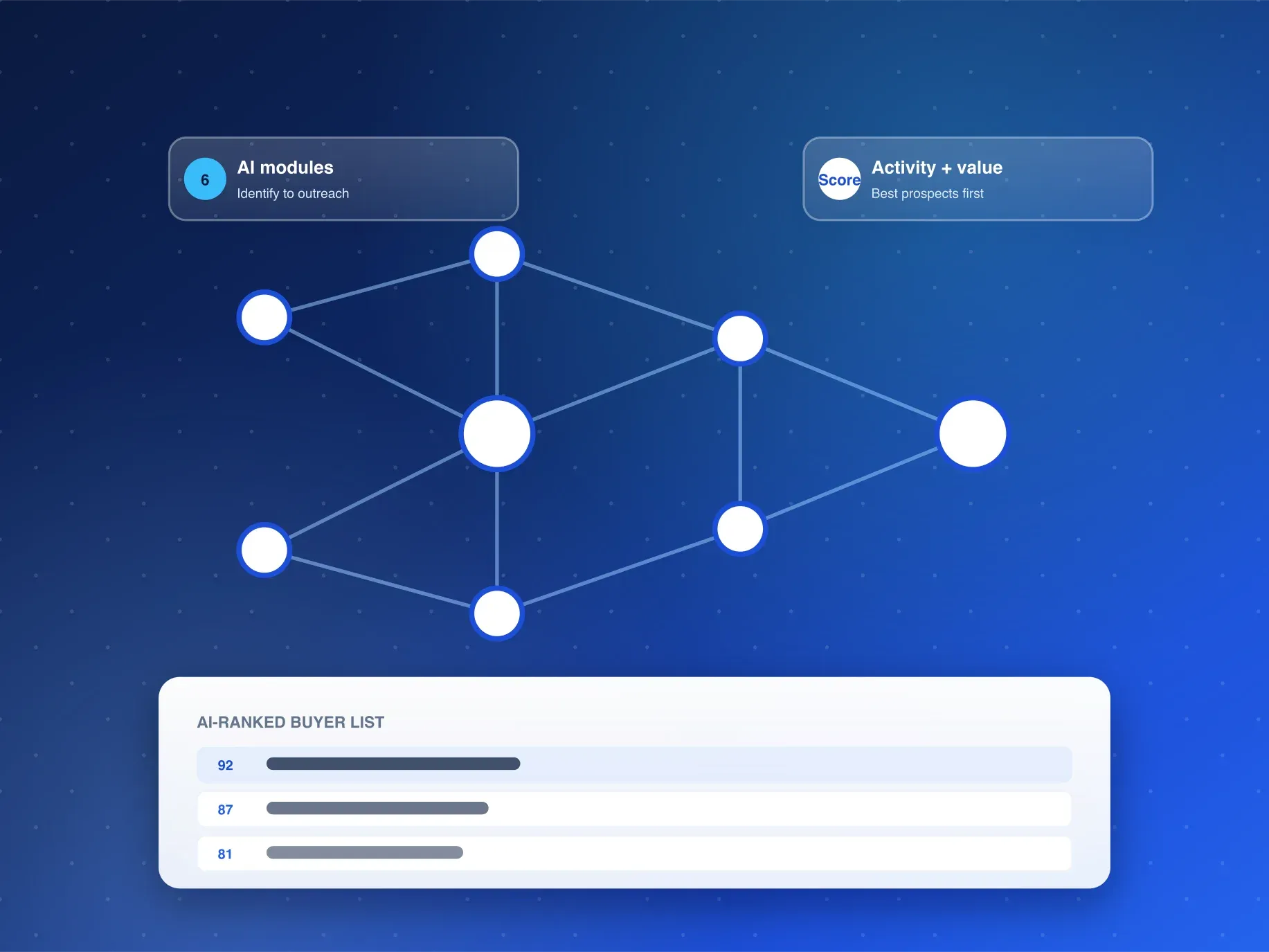
The candidate step is where automation earns its reputation. Scanning records for companies with the right category, direction and scale is repetitive, high-volume work with clear criteria — exactly the shape of task machines do well and humans do slowly. The AI Buyer Discovery Suite does its heaviest lifting in this step, and its six modules — identification, activity and opportunity value, market recommendation, similar-buyer discovery, outreach lists with emails and WhatsApp contacts, and competitor buyer detection — cover the search and the contact list that follows.
Step two: qualifying candidates (AI assists, rules decide)
Qualification has a mechanical core and a judgment edge. The mechanical core — frequency, recency, scale bands, role signals — can be scored consistently, which is precisely where a human solo operator drifts: attention varies with mood and calendar. The judgment edge — whether this pattern means an opportunity or a trap — resists scoring. The honest division is a scored shortlist that a person reviews, not a score that decides alone.
Buyer tip: keep the qualification rule human-authored and machine-applied. A rule you wrote and can defend is auditable; a score nobody can explain is a liability the moment someone asks why this account is on the list.
A practical way to keep the division honest: score with checkboxes, not with a single number. Each qualification criterion — repeat rhythm, recency, scale band, role fit — gets its own yes/no, and the shortlist is the set that clears the boxes. A checklist of separate judgments stays explainable; a single composite score hides exactly the disagreements a reviewer would want to see.
Buyer tip: test the tool on accounts you already understand. Take five companies you have qualified by hand, run the candidate and scoring steps on them, and compare the output with your own list; a tool that misses what you already know will not find what you do not.
Step three: the first message (AI drafts, the record supplies)
Drafting is a real gain, with a condition: the message's value comes from the observed facts it cites, and those facts come from the records, not from the model. AI can shape a letter quickly and in the right register; it cannot know what this account actually bought unless the record is fed to it. The workflow that works is records first, draft second — a model writing from a blank page produces exactly the generic letter most buyers have learned to ignore.
Step four: the relationship (AI cannot)
Here the boundary is sharp. Deciding how hard to push, reading what a buyer's silence means, knowing when a price is a test and when it is a boundary, remembering the personal context of a two-year relationship — none of this is a task an algorithm does. Tools can remind, log and draft, but the relationship itself remains the human's work, and campaigns that try to automate it produce the uncanny, obviously-machine letters that harm more than silence.
There is also a diagnostic value in the boundary: when a tool's demo is all relationship-language — it understands your buyers, it builds trust — the claims are landing on the human side of the line, where no product can deliver. When the demo is all hours-saved on candidate work, the claims are checkable against your own list, which is the honest place to evaluate.
Step five: reading the market (AI sorts, humans conclude)
Market reading splits the same way. Aggregation, comparison and pattern surfacing over many records are machine work; deciding what the pattern means for a business — whether a growing category fits your capability, whether a quiet one is a pause or a verdict — is not. The useful division is the machine preparing the comparison and the human drawing the conclusion, with the conclusion traceable back to the comparison it came from.
Where the boundary actually sits
Across the five steps above, the same line holds: AI is strong where the task is defined and repetitive, and weak where the task requires context that is not in the data. An honest evaluation of a sourcing tool can then be reduced to one question — which step is it claiming to automate, and is that step on the machine-strong side of the line?
That question also protects the budget: tools that claim to automate the relationship step are selling a promise, tools that remove hours from the candidate and contact steps are selling work. Knowing which is which is most of the buying decision.
Frequently Asked Questions
Can AI replace a salesperson in export sourcing?
No. It can remove hours from candidate finding, scoring and drafting, but the relationship — judgment, negotiation, memory of context — remains human work, and letters that try to automate it read as machine-made.
Which step gives the biggest gain from automation?
Usually the candidate step and the contact bridge: both are repetitive, high-volume and defined, which is where the hours go. Qualification is a scored assist rather than a replacement, and relationships are untouched.
How do I test the tools against my own campaign?
Start with a live sample on your own category. Tell the team what you sell via the inquiry form or WhatsApp; current records for your line arrive in 24 hours (Mon-Sat, GMT+8), and the machine-strong steps can be judged against that list.
Buy the work, not the promise. Take a Customsdatas sample for your own product line, then score each tool against the step it claims to automate within 24 hours.