Sep 28, 2026Country Guides
United States Customs Data (2026): Reading the Supply Side First
The US import field set names exporters — so the fastest honest entry into this market is the supply side. Read who already ships your category, at what scale, before you build a buyer list.
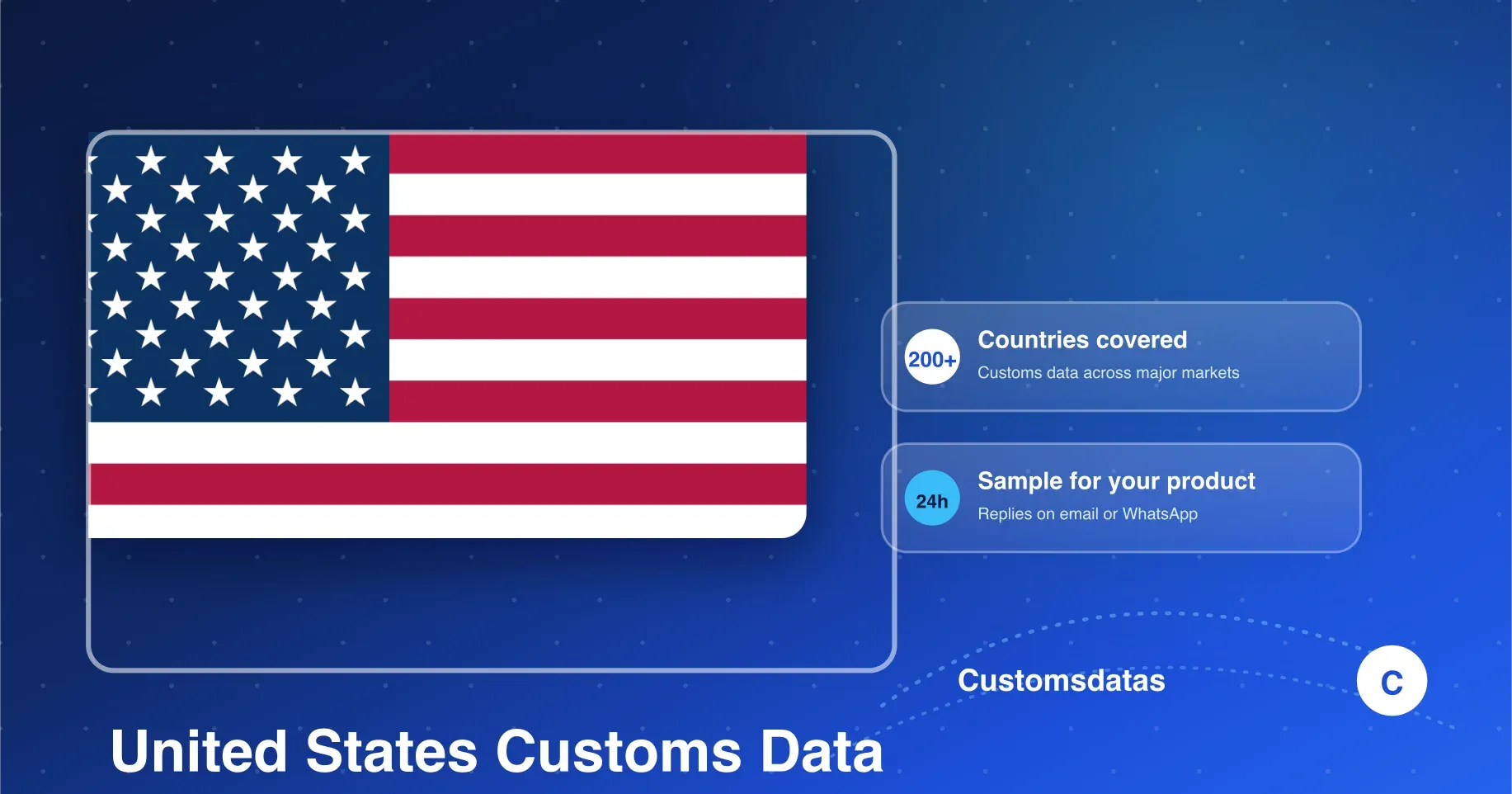
The United States arrives on Customsdatas with three layers — trade, shipping and statistics — English records, a regularly refreshed window, and a detail that shapes the whole approach: the import field set names exporters. The listed import fields are exporters, product description, HS code, quantity, weight and value; the export set lists product description, HS code, weight and value.
Because the import side carries the exporters field, the fastest honest entry into this market is the supply side. Before asking which American buyers might want your product, you can see who already ships that category into the country, at what scale, and under which codes. That baseline does two jobs at once: it maps the competition you would be entering, and it points to the corners where supply is thin.
The supply read, and why it comes first
The familiar approach reads imports as demand: who is buying what, how often, how much. The supply-side entry inverts the same records. Every inbound movement has a supplier behind it, and reading those suppliers as a set answers the first three questions a serious US campaign needs: which codes carry the trade, how crowded each of them is, and at what scale the players operate.
For an exporter weighing entry, that is a stronger opening than a raw buyer list, because it is answerable immediately from the fields already listed for this market — no assumptions about how buyers behave are needed to count who sells.
The exporters field as a landscape
Read one record and the exporters field is a name. Read it across a category and it becomes a landscape: a set of suppliers, each with a scale band and a rhythm, distributed across the codes that define the category. Crowding, concentration and gaps all become visible in the shape of that distribution.
Buyer tip: read the exporters field across a whole category, not one code at a time. Crowding shows up in the distribution, not in any single row.
The landscape is also the honest way to choose a battlefield. A code where a handful of exporters dominate reads differently from one with a long tail of small shippers, and the two call for different entry plans before any buyer work begins.
Searching by words and by code
Because the import set lists product description and HS code together, a category can be approached from either direction: by wording, when you think in products, or by code, when you think in classifications. Running both and comparing the results is the cheapest quality check the dataset offers.
Where the two searches agree, the category is well defined and the reading can proceed. Where they diverge, the divergence itself is a finding — descriptions drift with marketing language while codes stay put, and knowing which axis is steadier tells you which one to trust for a long-running read.
The export set without quantity
The export field set lists product description, HS code, weight and value — weight and value, but not quantity. That asymmetry deserves a planning decision rather than a shrug: comparisons between inbound and outbound flows of a category can be made on value and on mass, but not on units.
Buyer tip: keep unit economics on the import side of your sheet. The export set carries no quantity, so rebuilding them there means guessing, which the records themselves never asked you to do.
Read the export numbers as value-and-mass flows. They are excellent for structure — which goods leave, in what weight and worth — and the import side remains the home of anything counted in pieces.
English records, sea coverage, regular refresh
Records are in English, which removes the translation step entirely and lets search terms from your own catalog go straight into the file. No air component appears in the listed coverage, so plan a sea-freight read and leave air out of the model rather than paying for a comparison the coverage cannot support.
The window refreshes on a regular cadence, which means the supply landscape you build is a living baseline: the same read can be repeated later and compared, and the comparison — not any single snapshot — is what shows movement in the category.
Where the baseline pays off
With the supply landscape in hand, buyer work gets sharper. You can prioritise the codes where supply is thin relative to the flow, and you can approach the categories where your own position would be defensible rather than merely busy. The baseline turns target selection from a hunch into a comparison between landscapes.
That baseline then goes to the AI Buyer Discovery Suite, whose scoring and contact pass produces identification, activity and opportunity value, market recommendation, similar-buyer discovery, outreach lists with emails and WhatsApp contacts, and competitor buyer detection. Its ranking works on whatever it is given, and a supply-side baseline gives it a category that has already been checked once.
Practicing on your own category
The field set for this market is already listed, so the remaining unknown is practice: how densely the exporter field is populated in your specific category, how descriptions read in your product language, and how tight the refresh rhythm runs. A sample run answers all three against your own product line rather than a generic one.
Read the sample as a rehearsal of the real read — same codes, same product words, same comparison between supply and flow — so that the first working session on US data is a repetition rather than an experiment.
Frequently Asked Questions
Which fields does the US coverage list?
Imports: exporters, product description, HS code, quantity, weight and value. Exports: product description, HS code, weight and value. Records are in English, with a regularly refreshed window and no air component in the listed coverage.
Why begin with exporters instead of buyers?
Because the supply landscape is the fastest honest read of a category: crowding, scale bands and code distribution are all visible before any buyer research. It also gives your first messages a factual baseline instead of an introduction.
How do I get a US sample?
Send your product line through the inquiry form or WhatsApp; United States records come back within 24 hours (Mon-Sat, GMT+8).
Want to see who already ships your category into the United States? Request a free sample from Customsdatas and map the supply landscape within 24 hours.