Oct 5, 2026Country Guides
United Arab Emirates Customs Data (2026): Whose Goods Are These?
A hub market's movement records mix local demand with re-export and pass-through. How to attribute each flow before any volume number is allowed to mean demand.
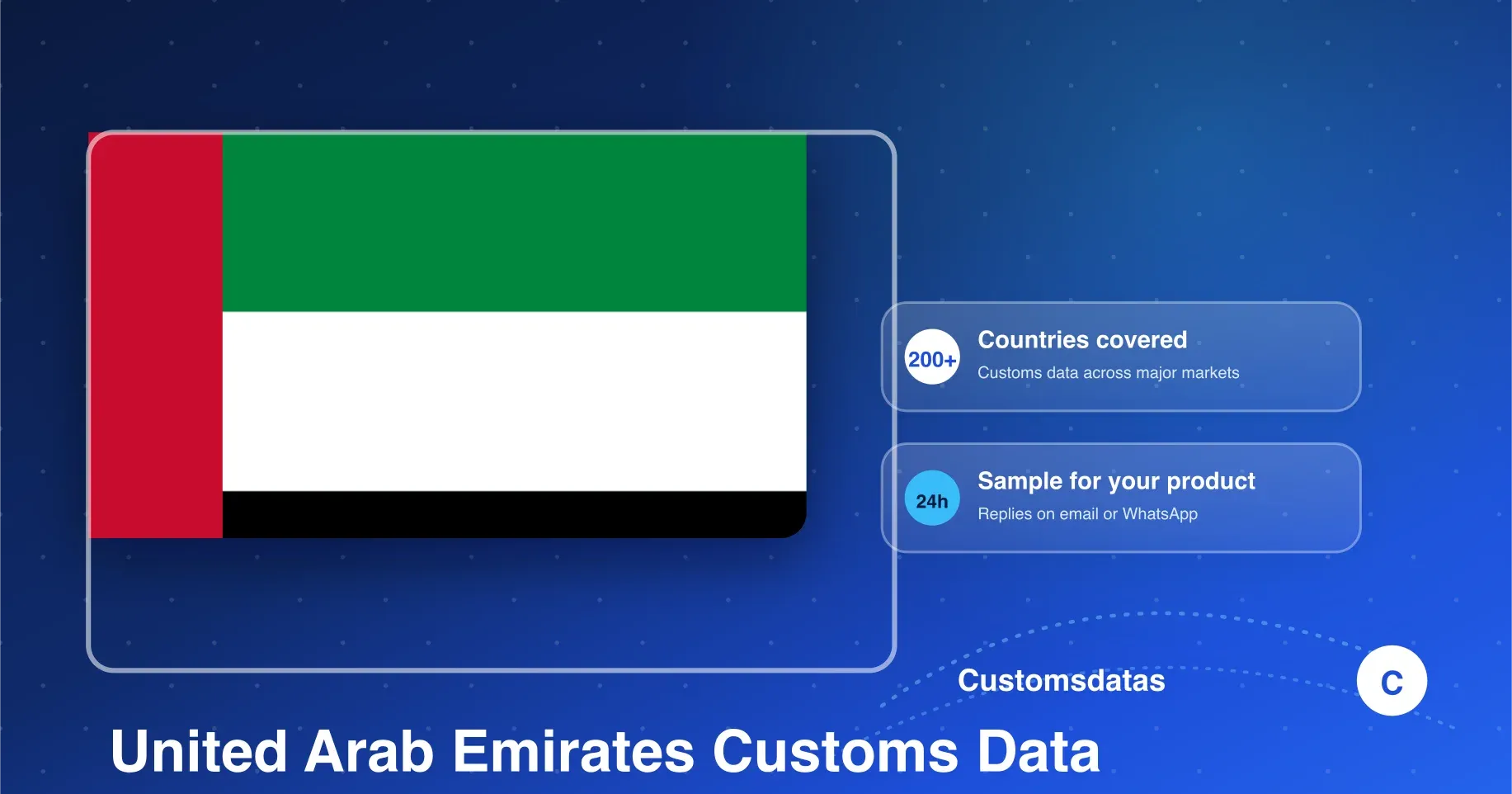
The United Arab Emirates carries a single documented layer on Customsdatas — shipping — with no field-level detail published for it in the coverage table, so the record specifics are settled on a sample run. A movement layer in a hub economy puts one question ahead of all others: for any flow you see, whose goods are they — and whose market do they ultimately serve?
In markets of the UAE's type, much of what moves tends to serve somewhere other than local demand: goods arriving for redistribution onward, consignments passing through on their way elsewhere, and only part of the visible volume staying to be consumed. Read without attribution, hub records can overstate domestic demand — most sharply in the categories where redistribution is common, which is often where the volume looks most tempting.
The ownership question comes first
A single layer keeps the method honest in a specific way: there is no second window to cross-check against, so every conclusion has to be built from the movement records themselves. That constraint concentrates all attention on one question — attribution — and the question is the right one for this market anyway.
Buyer tip: add an ownership column to your working sheet before any totals. Each movement line gets one of three labels — local demand, redistribution, or undetermined — and the totals only count what the labels support.
Tracing patterns, not events
The same physical cargo can appear more than once in movement records as it changes hands or means of carriage, and in a hub economy those appearances multiply. The read is to trace patterns rather than to sum events: one party appearing repeatedly with consistent goods is a working channel, while the same cargo appearing under several names is distribution activity, not several buyers.
This is also why pace beats totals here. A party present across many periods, moving goods of one family, reads as a dependable channel regardless of how the raw counts inflate; a single burst of appearances reads as throughput with no relationship attached.
The practical caution speeds follow from the same point. A hub file invites two shortcuts — summing every appearance as if each were a separate sale, and treating every large volume as local appetite. Both shorten the read and both misprice the market; the ownership column exists to prevent exactly these.
Three kinds of flow in one file
Practically, the flows resolve into three families. Local demand: goods that stop. Redistribution: goods that arrive and leave, forming the hub's commercial core. And pass-through: goods in transit whose economic purpose lies elsewhere entirely. The three mix inside the same categories, and separating them is what turns a movement file into a market read.
The label decides the count
The discipline's payoff is the order it imposes: attribute first, count second. A category whose volume is mostly redistribution is a channel opportunity — relationships with movers, not consumers. A category dominated by local demand is an end-market opportunity, read on its own terms. Counting first would have merged the two and misled the plan either way.
What one layer can and cannot settle
A movement layer settles what travelled and roughly how often; it supports attribution at the pattern level — who keeps moving, what kind of goods, in what rhythm. What it cannot settle from the table alone is the finer record grammar, and that gap is exactly what the sample run fills.
There is one more habit that keeps a hub read honest: verify the goods, not just the name. A channel party moving one product family consistently is legible; the same name surfacing across unrelated families may be an agent consolidating for many principals, which is a different relationship with different terms. Let the movement pattern, not the name alone, decide which reading fits.
Undetermined lines are worth revisiting, not erasing. A flow you could not attribute today may resolve once a channel party is identified or a destination pattern repeats; keep the open rows marked, and promote them when the evidence arrives. The ledger improves by resolution, not by deletion.
The ledger's ownership column
The output is a movement ledger with the ownership column filled: channels marked for redistribution, end-market parties marked for demand-side outreach, and undetermined lines left visibly open rather than silently averaged into anything. A ledger that shows its undetermined rows is one you can trust in front of a colleague.
The labelled ledger is the next input for the AI Buyer Discovery Suite, which runs six passes: identification, activity and opportunity value, market recommendation, similar-buyer discovery, outreach lists with emails and WhatsApp contacts, and competitor buyer detection. With the role written beside every account, the outreach splits cleanly between channel-building and end-market conversations.
Confirming the file grammar first
Before the first real session, confirm what the movement records actually carry — how entries are arranged, what a search returns, and how current the window is — on a sample run. One calibration pass keeps the whole attribution method sitting on real record grammar instead of assumption.
Frequently Asked Questions
What does the UAE's coverage layer include?
One documented layer, shipping. The finer detail of its records is not spelled out in the coverage table, and a live sample is what settles it.
Why attribute before counting?
Because in a hub economy, volume mixes local demand with redistribution and pass-through. Attribution separates the three; counting first would merge them and misdirect the campaign.
How do I start an attributed read on the UAE?
Ask through the inquiry form or WhatsApp and describe the line you sell; within 24 hours (Mon-Sat, GMT+8) the reply carries UAE movement records matched to it.
Wondering which share of your category actually stays in the UAE? Request a free sample from Customsdatas — the attributed ledger starts inside 24 hours.