Country Guides
South Sudan Customs Data (2026): A Query Notebook for Defensible Prospect Research in Trade-Only Samples
A trade-only research method for South Sudan that separates a search hypothesis, a returned sample, and buyer qualification without assuming country-specific fields or coverage.
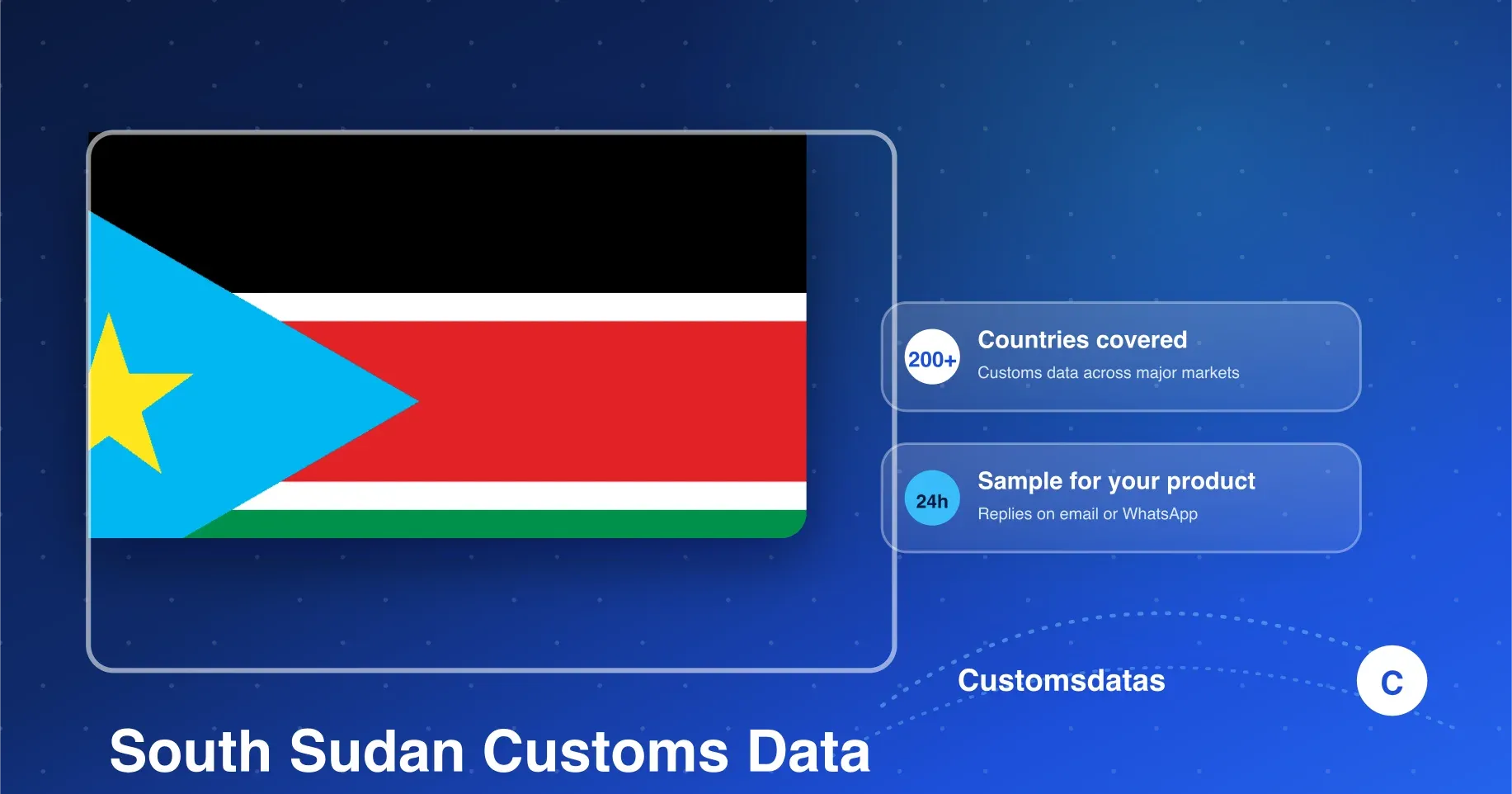
The current Customsdatas queue identifies South Sudan under the trade data category. It does not provide a country-specific field list, reporting direction, or coverage note. That distinction should shape the article and every sales conversation: a trade category is a starting point for a test, not proof that a particular company, product, or transaction can be retrieved.
For an exporter or analyst, the useful first output is not a long lead list. It is a compact decision record showing what question was asked, what the returned sample demonstrates, what remains unknown, and what evidence would justify the next step. This keeps prospecting grounded while field-level availability is still unconfirmed.
Turn a sales brief into a falsifiable test
Begin with a decision that can be checked: whether a defined product family appears in a requested trade-data sample, whether the observed activity is recent enough for a chosen workflow, or whether a possible trading relationship deserves manual review. Avoid framing the question as “Who are the buyers?” before the sample shows what party information, if any, is available.
Write down the hypothesis and a rival explanation. A product phrase may match a broad category, a code may include unrelated goods, or an apparent gap may reflect the selected period rather than an absence of trade. Recording both the expected result and a plausible alternative makes the first search falsifiable.
Create a controlled vocabulary from the product brief
Describe the product in plain language, then list synonyms, material terms, functional terms, and exclusions. Do not assume that every phrase is indexed or that a particular HS level is present. Treat classification as a candidate route into the sample and record which wording or code was actually tested.
Keep one change per query revision. If you change the product phrase, time window, and geographic scope together, you will not know which change altered the result. A simple query log with version, reason, and expected effect makes a later comparison useful instead of anecdotal.
Attach a time window to every observation
Every finding should carry its requested time range and the date on which the sample was checked. A short window may suit a current prospecting experiment; a longer window may help test whether a signal repeats. Neither window should be described as complete national coverage unless source documentation explicitly supports that claim.
Ask whether the returned sample is organized by event date, publication date, or another time basis. If that distinction is unknown, leave it open in the notes. Do not infer a trend from rows that may represent different reporting periods or revisions.
Keep source observations outside entity qualification
A record-level match can support a narrow statement: the sample contains an observation matching the tested query under the displayed scope. It does not, by itself, prove that an organization is the end buyer, that a contact is responsible for procurement, or that a transaction is still commercially active.
Keep product fit, organization identity, and buying intent in separate fields in your working sheet. Mark each as observed, corroborated, or unverified. When the source does not expose enough detail to distinguish a legal entity from a trading label, do not silently promote the label into a verified company.
Ask the sample to show its own boundaries
Before building a large workflow, request a small sample for the exact query you intend to use. Ask the provider to identify the source category, date range, country scope, available record granularity, and any known exclusions. Ask which fields are present in that sample rather than assuming a standard list applies to South Sudan.
Check whether the sample can be traced back to its source and whether the same query can be repeated. If a field is masked, missing, or inconsistently populated, record that as a limitation. A useful sample is one that exposes its boundaries, not merely one that contains a promising row.
Diagnose thin and crowded result sets differently
If a search returns few observations, test the product wording and classification separately before concluding that demand is small. A narrow phrase, an overly specific code, or an unsuitable period can all suppress a result. Change one variable at a time and keep the previous version so the reason for the change remains visible.
If a search returns many observations, sample them rather than treating the count as a qualified prospect total. Check whether the rows represent distinct organizations, repeated events, or broader categories. Where the sample does not support that distinction, report a range of uncertainty rather than a precise buyer count.
Require a second identity check before contact
A prospect should move forward only when the product match is relevant, the organization can be identified independently, and the commercial reason for contact is clear. These are separate checks. Trade evidence may help prioritize research, but it does not replace a current company website, product catalogue, or human review of the intended recipient.
For a first outreach test, choose a small group of records that pass the same documented rules. Keep the query version and sample date with the outreach result. Buyer tip: ask the sample provider to show the exact query and source date beside each returned observation before a name reaches the sales queue.
Keep unresolved assumptions in a separate appendix
A short brief should state the question, tested query, time window, sample source, and checks completed. Add a separate section for unknowns: field availability not confirmed, coverage not measured, entity identity not independently checked, or trend interpretation not supported. This makes the output usable by another analyst without overstating what the data proves.
For South Sudan, the queue currently confirms the trade category only. A field-by-field capability statement, a named buyer example, or a country-level trade total needs separate evidence before it belongs in a report. The most credible next step is to validate the requested sample and update the brief with what it actually contains.
Frequently Asked Questions
FAQ: Does the South Sudan trade category confirm specific company fields?
No. The current queue entry confirms a trade-data category but contains no country-specific field detail. Request and inspect a sample before describing available parties, product fields, or identifiers.
FAQ: Can a small sample prove market size?
No. A sample can show what was returned for a defined query and period. It does not establish full national coverage or a complete market total unless the underlying source and method support that conclusion.
FAQ: What should an exporter do first?
Define one product question, freeze the query and time window, then request a sample to confirm scope. Only after the returned evidence is understood should the team qualify organizations and prepare outreach.
Explore South Sudan trade data on Customsdatas and request a sample to confirm the available scope before planning prospect research.