Oct 5, 2026Country Guides
Singapore Customs Data (2026): Two Layers, Cross-Examined
Trade and shipping layers describe the same commerce from two sides. Align them like two accounts of one event — and treat every disagreement as the place to look closer.
Singapore's coverage on Customsdatas runs two layers deep, trade and shipping, and the record set is complete in both directions: exporter names, product description and HS code alongside quantity, weight, value and brand — in English, with air freight covered and updates delivered in a limited version.
Two layers describing the same commerce are, in effect, two accounts of the same event. The productive way to read them is the way a careful examiner reads two testimonies: align them first, then spend your attention precisely where they disagree. Agreement is comforting but adds little; disagreement is where trade actually becomes visible.
Putting the layers side by side
Alignment means picking a category and a window and reading both layers against the same frame — same product family, same period, same direction of trade. Only when the frames match can a difference between the layers mean something. An unaligned comparison produces noise and calls it a finding.
Buyer tip: run the alignment on paper before drawing conclusions. Two columns, trade side and shipping side, one line per party or category slice — and the comparison reads itself.
The valuable part is the mismatch
Disagreement between the layers comes in shapes worth recognising. A party busy in trade records but quiet in shipping may declare goods that move through other channels; a party busy in shipping but thin in trade may be handling goods it does not own. Both shapes are fingerprints — and both are visible only because you looked at the same commerce twice.
The reading discipline is to record the mismatch, name a hypothesis, and let the next layer of evidence — usually the first conversation — settle it. A mismatch written down is intelligence; a mismatch averaged away is a lost finding.
Same three anchors on both sides
With the full field set available, each layer supports the same three handles: the exporters field attaches names, the HS code fixes the category, and the brand field shows whether a flow runs on labels or on specification. Reading both layers through the same three handles is what makes the cross-examination clean — the only differences left are the real ones.
Working with a restricted refresh
The update channel for this market is a limited version — the file refreshes, but not with the full cadence you might expect in a larger-coverage market. Plan for it by dating every pull: an undated file can look current when it is not, and an unrecorded vintage will quietly distort the comparison built on it.
A third vantage from the air lanes
A limited refresh also changes what a mismatch means. Where the two layers carry updates of different reach, some disagreements may reflect timing rather than fact — so date each layer separately, and treat only same-window differences as findings. The discipline is small and it saves an entire category of false alarms.
Air freight coverage adds a third axis to the cross-examination. Lighter or higher-value categories often show a different cast of parties in the air lanes than in the surface trade, so where both exist, the air roster is a check on the conclusion: a party you judged peripheral on the surface may be central in the air, or the reverse.
What the reconciled sheet hands over
The work product is a reconciled sheet: parties aligned across the two layers, disagreements logged with hypotheses, brand and scale notes attached, and dates on every pull. Resolved this way, the list carries something a single-layer read cannot — a note on what each account looks like from two independent angles.
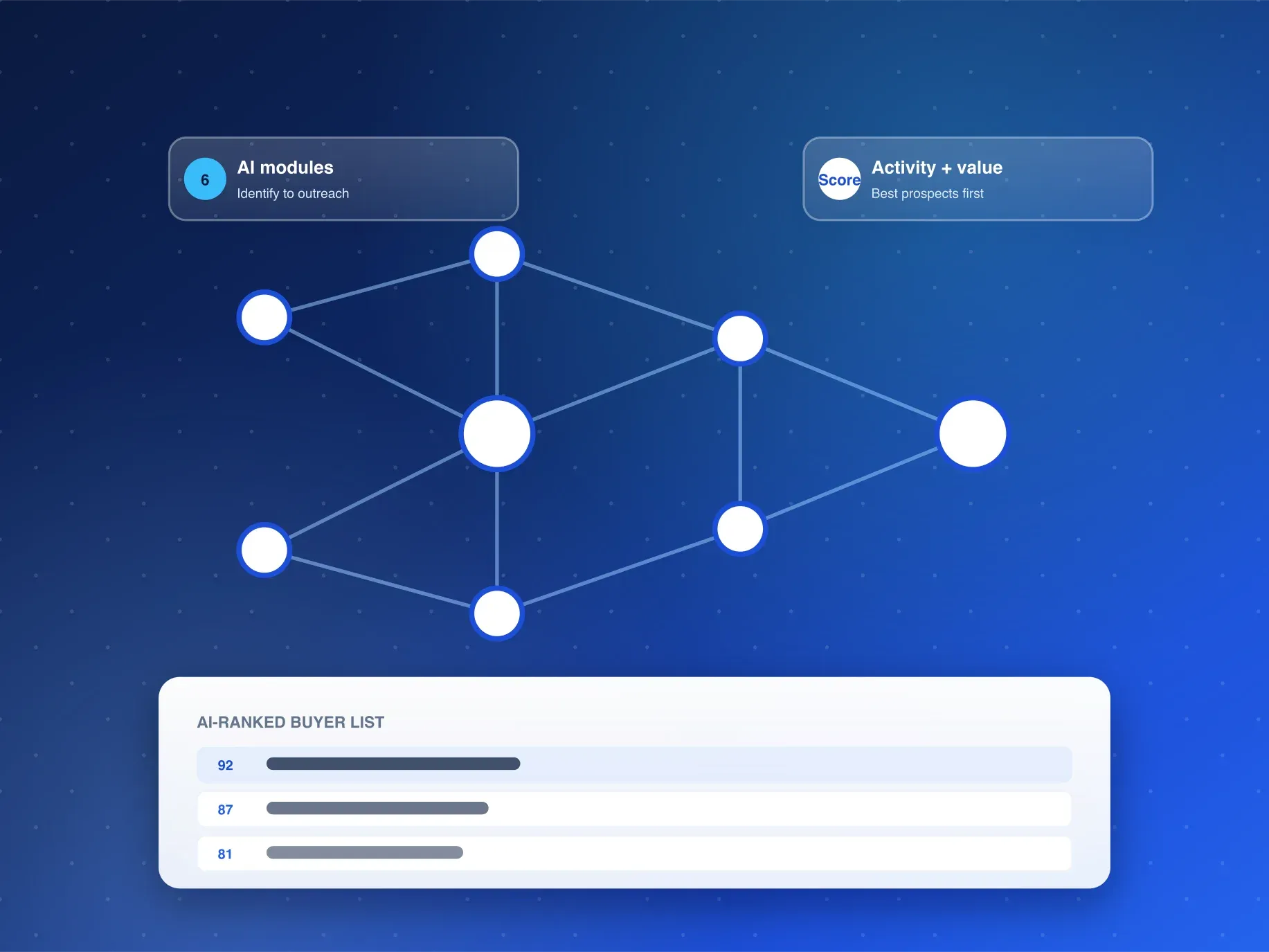
The reconciled sheet is then handed to the AI Buyer Discovery Suite, whose six modules run in order: identification, activity and opportunity value, market recommendation, similar-buyer discovery, outreach lists with emails and WhatsApp contacts, and competitor buyer detection. Those mismatch notes become the informed opening lines of the first letters.
The reconciled sheet also settles argument ordering inside a team. When two readers draw different conclusions about the same account, the sheet shows which layer each read leaned on and whether the layers agreed at the time of reading. Disagreement about conclusions becomes disagreement about a specific mismatch — a much smaller and more answerable thing.
Re-run the alignment when the market's refresh schedule produces a new file, and keep each run dated. Rows migrate between the two columns: some mismatches resolve into alignment, and some aligned pairs fall back out. Treat each migration as a new question about the account — a line for the sheet, not a conclusion.
Reading the sample as a rehearsal
One sample run against current data settles how each layer's records behave in practice — how parties and goods appear, how the window sits, and what a limited-version update contains on the day you read it. Every method above stays a hypothesis until that pass confirms it against the real columns.
Bring the alignment frame to that sample read: same category, same window, both layers on one page. Reading the sample the way you intend to read the market is what turns the calibration from a formality into the first real pass — and it usually surfaces one or two record quirks worth writing into the sheet's header before the working session begins.
Frequently Asked Questions
What does Singapore's coverage list?
Two layers — trade and shipping. Both sides carry the same seven items: exporter names, HS code and product description, plus quantity, weight, value and brand. Records are in English, air freight is covered, and updates arrive in a limited version.
Why read the two layers against each other?
Because agreement is expected and disagreement is informative. Aligning the two accounts turns every mismatch into a question worth asking — and questions are what first contact is made of.
How do I start the cross-examination?
Two routes in, the inquiry form or WhatsApp. Name your product line, and a Singapore sample built around it lands inside 24 hours (Mon-Sat, GMT+8).
Need both layers of your category on one reconciled sheet? Request a free sample from Customsdatas — the alignment read follows inside 24 hours.