Sep 24, 2026Country Guides
Palestine Customs Data (2026): Enumerating a Micro-Market Account by Account
When the buyer pool is small enough to enumerate, ranking wastes its subject. A complete-map method for micro-markets, from adjacency to sequencing.
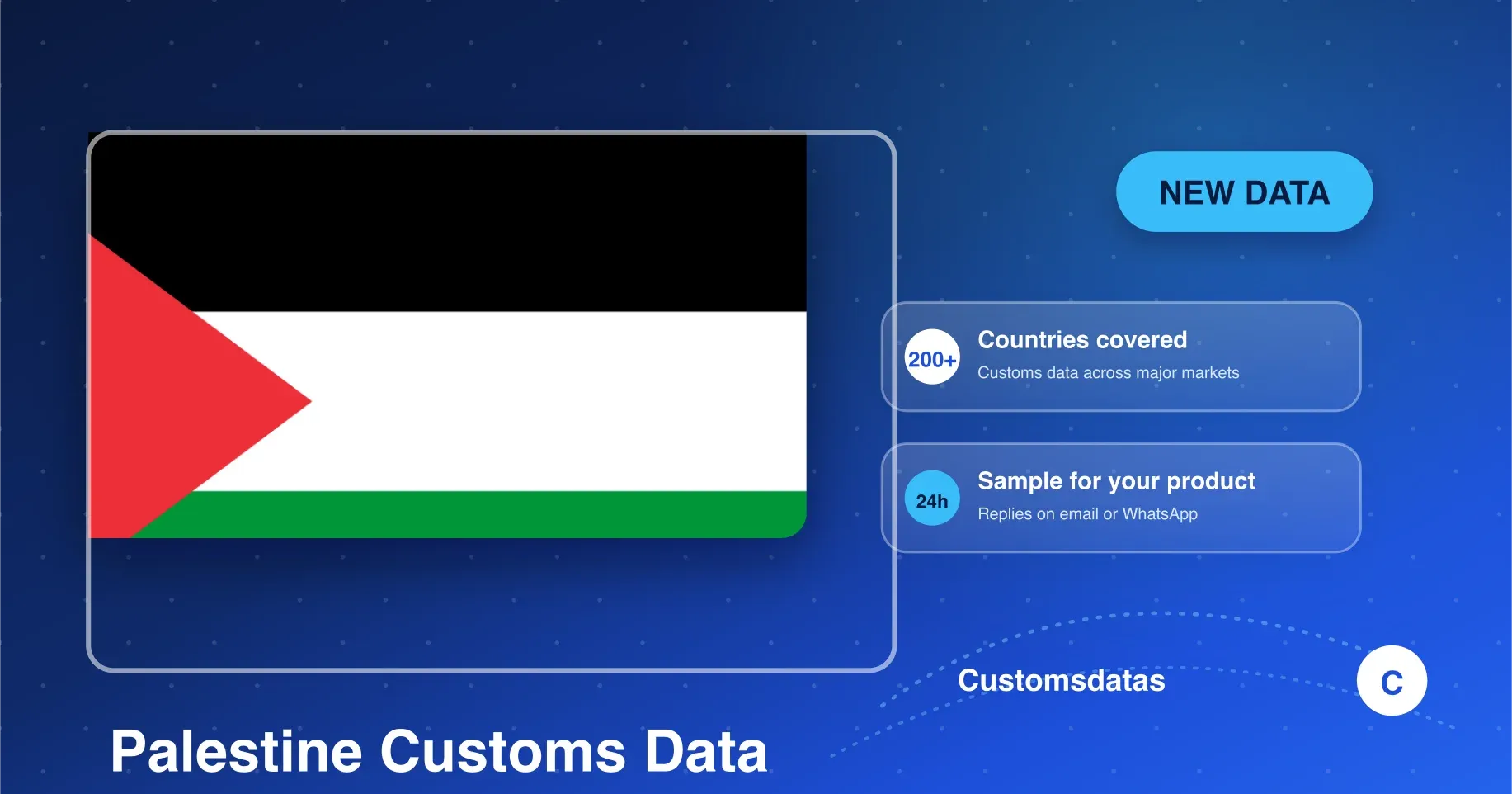
Palestine's records on Customsdatas are trade declarations only — recently added, and flagged as new coverage rather than as a new market to chase. In a market like this, the visible buyer pool is small enough that the standard motion — rank, slice, launch — wastes its own subject. When the pool is enumerable, the better motion is to map it completely, then to work it account by account rather than campaign by campaign.
What changes when the pool is enumerable
A ranking answers who is largest. An enumeration answers who exists. In a micro-market the second question is worth more, because the list is short enough that completeness — not selection — is the hard part, and every skipped account is a visible hole in the map.
Buyer tip: test whether a market is truly enumerable before committing to the method. If one careful pass under your category returns a pool you can read in full, enumeration wins; if not, return to normal ranking.
Building the complete map
Start from your category and read outward until the returns repeat. What your category search can reach is best confirmed on a sample run; once you have calibrated it, log every counterparty the returns bring, with three columns: what they trade, the scale of it, and the period they last appeared.
Completeness is the discipline. A map with obvious gaps misleads twice over — it understates the market and hides the accounts that would have anchored the plan.
Adjacency: one account points to the next
In compact markets, accounts cluster. Counterparties share counterparties: the same intermediaries, the same category channels, the same buying seasons. Read one account fully, and its patterns suggest where to look next — the map fills faster from the middle than from the edges.
Buyer tip: after every full account read, write one line predicting which account is adjacent, and why. Testing those predictions is how a beginner's map becomes a trader's map.
Sequencing, not spraying
The map changes the outreach order. Open with the best-read account in the densest cluster — a real observation about an account's trade lands hardest where the market is watching. Let each conversation inform the next; in a connected market, a reference travels faster than a campaign.
Spraying — blasting one message down the whole list — wastes the map's main advantage: each account is specific enough to deserve its own opening line.
Holes in the map are findings
In an enumerable market, a gap in your map is itself a result. A category that returns counterparties in every segment except one tells you something about either your search vocabulary or the market's structure — and chasing that gap, rather than ignoring it, is often where the least-obvious account lives. Note the gap, test one explanation, then move on.
Buyer tip: before calling a map complete, re-run one search with wider terms. If the wider run returns nothing the first pass missed, the map is complete; if it returns new names, the first vocabulary was too narrow.
The anatomy of a full read
A full read covers three things: the account's trading rhythm, the consistency of its category, and the shape of its orders — scale, regularity, direction. In an enumerable market all three are readable without statistics, simply by following the account's records across periods.
Two accounts that look identical in a ranked list usually split once read fully: one is a committed importer with steady channel needs, the other collects occasional deals. The map only pays if the read behind it is real.
Keeping the map alive
Micro-markets move in visible steps, so refresh on a calendar you set — quarterly is usually enough. Compare versions rather than starting over: new names, departed names and scale changes are the market's news, written by the market itself.
Buyer tip: date every version and keep the old ones. The delta between two dated maps is the closest thing a small market has to a market report.
What a micro-market carries
Expect precision rather than volume: a handful of durable relationships, each worth real attention. That arithmetic suits sellers whose product rewards depth — specification, continuity, service — and frustrates teams hunting scale. The market is telling you which kind of seller it wants; the map makes the answer visible.
When conversations begin, the AI Buyer Discovery Suite can extend the reach behind them — identification, activity and opportunity-value scoring, market recommendation, similar-buyer discovery, outreach lists with emails and WhatsApp contacts, and competitor buyer detection — but the map remains the plan.
One last note on expectations: a complete map is a finished instrument, not a finished business. It will show you a handful of real accounts and a clear picture of the market's scale — and it will not show a large one. Read that as the market answering honestly, and let the map's precision, not its length, be the point.
Completeness, though, is not a moat. In a market this size every serious seller can eventually assemble the same list, so what separates two of them is the quality of each read and the timing of each contact — not privileged access to the names.
Frequently Asked Questions
What coverage does Palestine have on Customsdatas?
Trade declarations, listed recently and marked with the NEW flag.
How large a list should I expect?
Test for an enumerable pool — one you can read in full — and switch from ranking to mapping only when it holds. Confirm your category's depth with a sample run.
How do I request the records?
Send your product name or HS code through the inquiry form or WhatsApp. The team replies within 24 hours (Mon-Sat, GMT+8) with records for your product line.
Want to build the complete map for your category? Request a free sample from Customsdatas and enumerate the Palestine records within 24 hours.