Oct 17, 2026Guides
The Minimum Viable Sourcing Stack for a One-Person Export Business
Running sourcing alone is not a smaller version of a team's workflow — it is a different composition. What the minimum stack actually needs, and what it can safely skip.
One-person export operations show up across trade communities, usually asking the same practical question: without a platform budget or a team, how does one person find and work buyers? The answers tend to list tools, and lists of tools miss the actual constraint. A solo operator does not need a team's workflow with fewer seats; the constraint is time, and the right composition is the minimum stack that keeps a sourcing loop running on the hours one person actually has.
This guide is about that composition: which pieces a minimum stack needs, in what order they earn their place, and which conventional pieces a solo operator can skip without losing the loop.
The constraint is hours, not tools
A team spreads a campaign across roles; one person carries every role in sequence. That changes what matters. A tool that saves a specialist half a day may save a solo operator nothing if it adds a learning curve; a modest tool that removes a recurring hour every week may be transformative. The sizing question is not which stack is most powerful but which stack fits the hours available — the minimum that keeps the loop alive.
Buyer tip: count your sourcing hours per week before buying anything. The honest number — usually smaller than expected — is the budget every tool on the stack must fit inside.
Piece one: a readable market source
The loop starts with evidence about who buys your category. That can come from a trade-data layer, from aggregate public statistics, or from both; what it cannot come from is intuition. The first piece earns its place by turning where do I start into a shortlist of named companies with observable activity. Whatever source you choose, test it on your own category before committing — the sample question applies to a solo operator more than to anyone, because there is no one else to absorb a wrong purchase.
Piece two: a qualification rule
The second piece is not a tool but a rule: the written standard that decides which companies from the shortlist deserve contact. Without it, the solo operator re-decides every case from scratch and burns the hours the stack was supposed to protect. With it, qualification becomes a pass over the list — repeat rhythm, plausible scale, recent activity — and the rule improves with each round instead of resetting.
Buyer tip: one page, five lines, written before the first outreach round. A rule that fits on a page gets used; a rubric that needs a meeting does not survive a solo week.
Piece three: the contact bridge
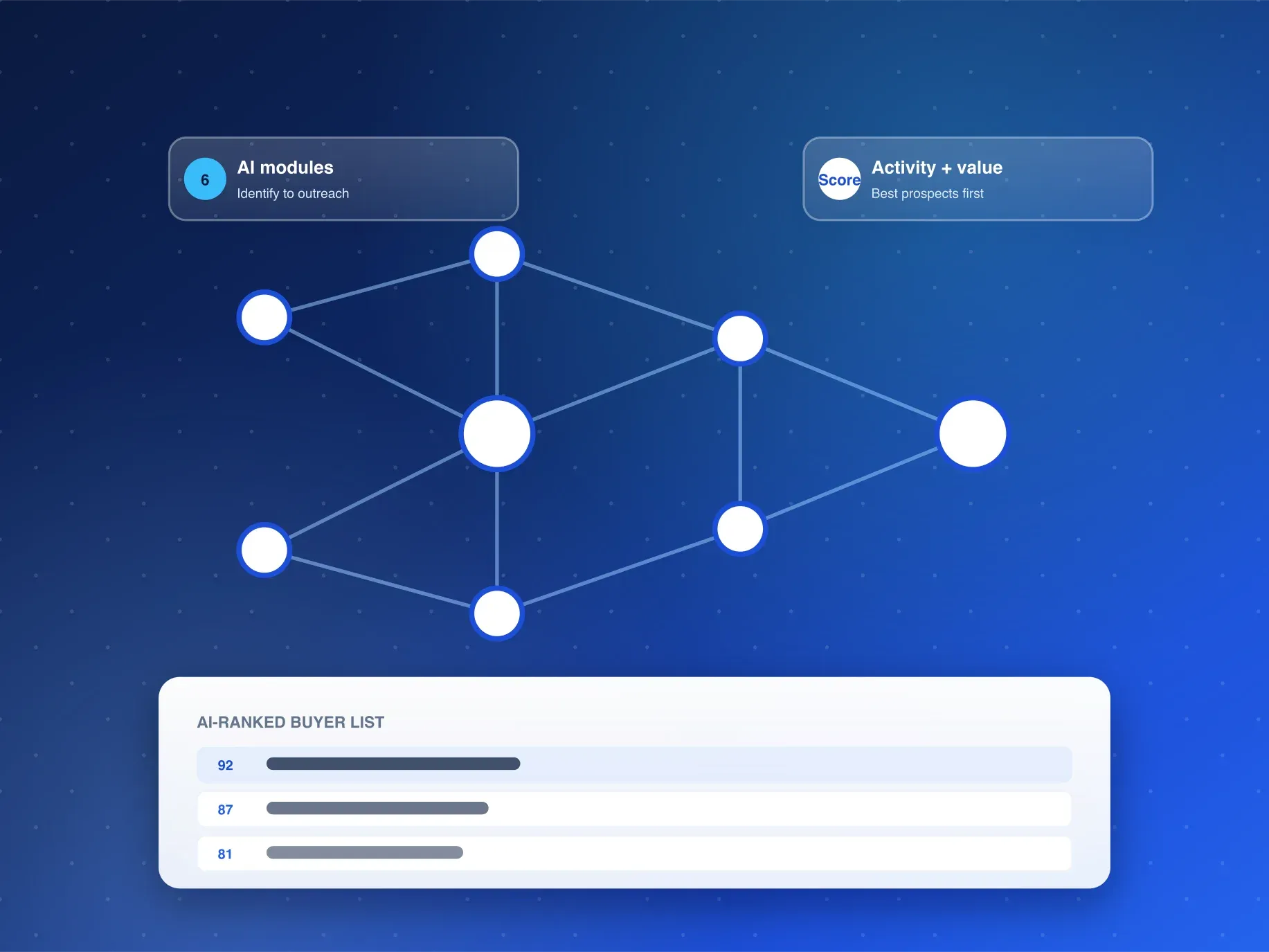
Records name companies; a solo operator needs people and channels. The bridge — finding the right role, confirming the channel, and reaching a deliverable address — is the piece most likely to consume a solo week if done by hand at scale. This is also the piece where a minimum stack most often delegates: the AI Buyer Discovery Suite handles it with its six modules — identification, activity and opportunity value, market recommendation, similar-buyer discovery, outreach lists with emails and WhatsApp contacts, and competitor buyer detection — so the hours go to judgment and letters rather than to lookup grinding.
There is a cheaper version of this piece worth knowing about, too: the manual bridge, run once, learned properly. A solo operator who has done the company-to-person work by hand for twenty accounts knows what good looks like — and can then judge any automated version against that standard instead of trusting a demo. The stack can delegate the bridge; the operator should still own the benchmark.
Piece four: one running file
The last piece is the smallest and the most often skipped: one file, dated, where every observation and every contact attempt lands. Not a CRM build-out — one sheet or one document with a date column. It is what turns a solo operation from a series of disconnected sessions into a loop that remembers, and memory is the solo operator's main defence against redoing the same week twice.
The file also settles a solo operator's most common anxiety — am I doing enough? Volume goals are team metrics; a solo loop is measured by continuity instead: did this week's pass happen, did the shortlist grow or sharpen, did any conversation move. Three questions, one file, and the answer stops depending on mood.
What the minimum stack can skip
The skip list matters as much as the stack. A solo operator can skip multi-seat anything, elaborate dashboards that go unopened, and any automation whose setup time exceeds the hours it saves. The test for a candidate tool is one sentence: does it remove a recurring hour, this month, with the list I have? If not, it is a team tool wearing a solo price.
The composition that survives contact with a real solo week is unglamorous: a tested market source, a one-page rule, a delegated contact bridge, and one dated file. Four pieces, each earning its place, and nothing else until the loop is running.
Frequently Asked Questions
Can one person really run a sourcing campaign?
Yes, with a composition built for one person's hours rather than a team's roles. The minimum stack is four pieces: market source, qualification rule, contact bridge, and one dated running file.
Which piece should a solo operator delegate first?
Usually the contact bridge — finding roles and verifying channels is the most repetitive, highest-volume step. Delegating it frees the hours that judgment and writing actually need.
How do I test a market source before paying?
On your own category, before any commitment. Send the product line you sell in a request via the inquiry form or WhatsApp; an answer comes back in 24 hours (Mon-Sat, GMT+8).
Build the loop around the week you actually have. Ask Customsdatas for a sample built around the product you sell, and put the first piece of the stack to work within 24 hours.