Sep 22, 2026Country Guides
Nigeria Customs Data (2026): The Code-First Market
Nigeria's import records carry no product description field. A code-first qualification workflow for a purely quantitative dataset.
Nigeria carries a HOT flag on Customsdatas, and its records are defined by what is missing: the import side carries no product description field, and the export side is not part of the coverage at all. The market is searched by code and by party rather than by words, so the first useful move is mapping your product's code family.
For teams used to keyword-first discovery, that sounds like a limitation. In practice it enforces a discipline that produces better lists: you qualify by what was actually declared — exporter, HS code, quantity, weight, value — instead of by how elegantly someone described the goods.
What the import side exposes
Nigerian import declarations open five fields to search: the exporting party, the HS code, the quantity, the weight and the value. Every field is quantitative or identity-based; none is prose. The record tells you who ships in, under which code, at what scale — and stays silent on descriptive language.
That field mix suits exactly what qualification needs. The exporting party and the code locate the trade; quantity and weight measure its mass; value places it economically. There is no advertising copy in a customs declaration — only the transaction itself.
Buyer tip: assemble your search around the code lattice rather than a single code. Nigeria rewards pulling the four-digit family, then the six-digit children, and keeping the parties that appear across several of them.
Why code-first beats keyword-first here
In markets with description fields, keyword searches catch loosely classified goods — at the cost of noise. Nigeria removes the noise by removing the words. Your search quality is then a direct function of how well you know your product's classification, which is a one-time investment that pays across every code-based market you touch.
If your classification is uncertain, treat the first sample as a calibration run: request records across the neighboring codes, see which ones carry the parties and volumes that resemble your category, and narrow from there. The codes teach you the market faster than any keyword list would.
English records, African gateway position
Nigerian records are kept in English — a real convenience in a market that is otherwise a gateway between West African demand and global supply. And because the field set is identity-based, language never enters the search equation the way it does in description-capable datasets.
Position Nigeria accordingly: as an import-facing market where the data shows precisely who brings goods in and at what scale. The absence of descriptive fields makes it a clean quantitative market — every row is a fact about a shipment, nothing more, nothing less.
Air cargo and how current the records are
Air cargo is covered too — relevant when your goods move by air into West Africa: components, specialty goods, samples. The file is refreshed on a regular cadence, so you are looking at live trade rather than history.
Buyer tip: in an import-only dataset, frequency across periods is your primary qualification instrument. A Nigerian importer appearing under your code family every quarter is a working supply relationship; plan the outreach around its rhythm.
Calibrating your code lattice before outreach
The code lattice deserves a proper calibration pass before any Nigerian outreach begins. Pull your four-digit family with a wide date window, list the six-digit children that carry volume, and mark which parties appear under more than one child. Parties spanning several codes are rarely single-line buyers — they run broader sourcing programs, and they respond to a wider version of your offer.
This calibration also flushes out classification surprises: subsidiaries of the same group declaring under different codes, or one product family split across two headings by different importers. Either finding reshapes your targeting in minutes, and both are invisible in a keyword-first workflow.
Where a wordless file misleads
The first trap is searching one code and calling it a market. The second is ranking purely by value in a market where currency movement can distort single-period figures — recurrence across periods is the steadier signal. The third is forgetting the weight column: in a dataset this quantitative, weight and quantity together read product mix, and mix is where your offer either fits or does not.
None of these traps is exotic; they are the ordinary disciplines of quantitative search. Nigeria simply rewards them more visibly than markets where words soften the signals — every row is a shipment, and the discipline compounds across every code-based market your team will ever work.
Scoring the code-based shortlist
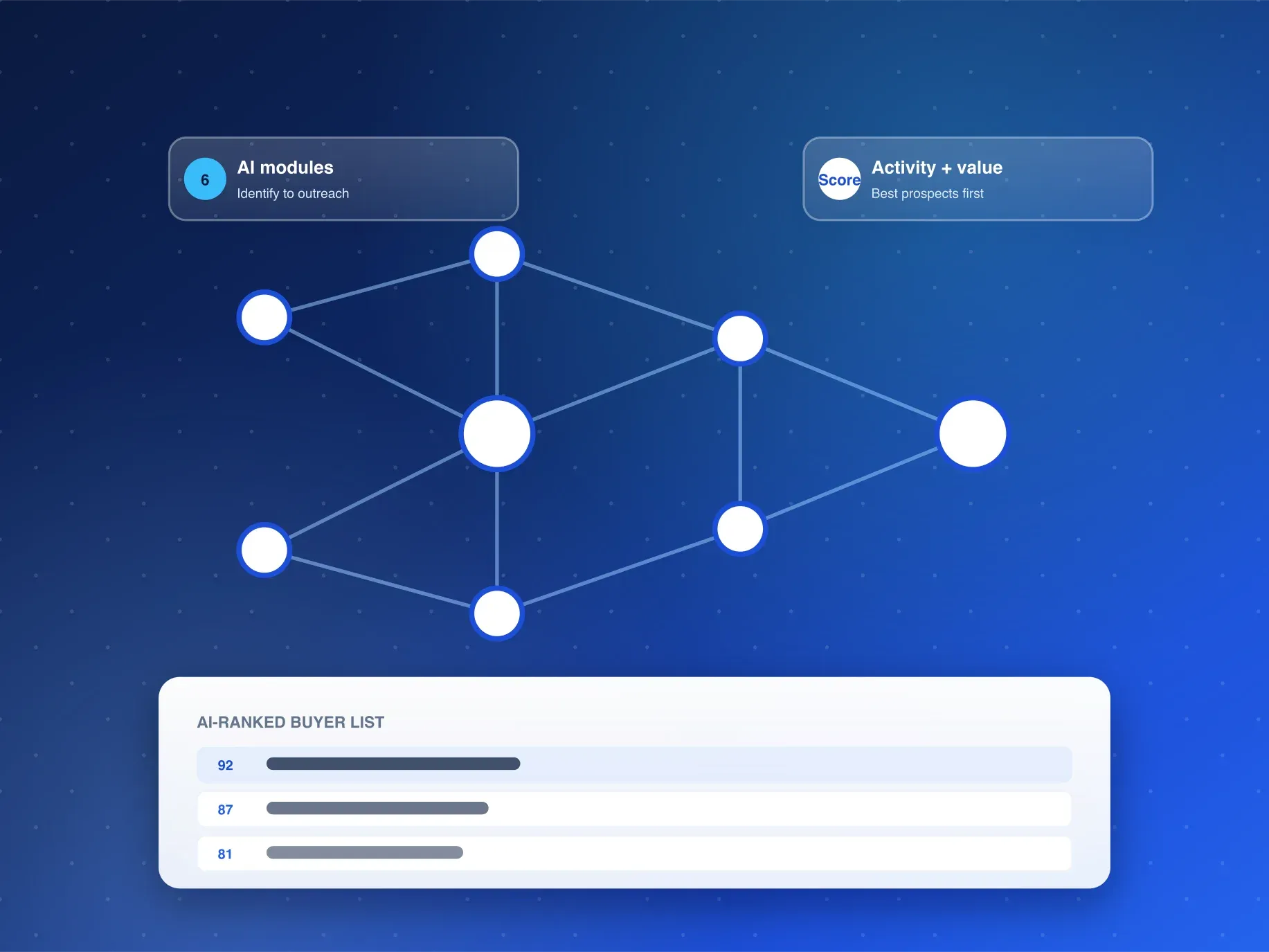
When the code-based list is ranked, the AI Buyer Discovery Suite runs the scoring pass — activity and opportunity value — and produces outreach lists with verified emails and WhatsApp contacts, with the similar-buyer and competitor modules extending reach. On a quantitative dataset like Nigeria's, scoring is the bridge from rows to conversations.
Finally, keep your code lattice documented as it evolves. Classification practice shifts, new headings get adopted by importers, and the lattice you calibrate this quarter becomes a reusable asset across every future search — in Nigeria and in every other market your team works by code.
Frequently Asked Questions
Is there a product description field for Nigeria?
No — the import record set covers exporting party, HS code, quantity, weight and value. Searches are code- and party-driven, which keeps results quantitative.
Does the coverage include Nigerian exports?
The current coverage is the import side, which is the direction that matters most for finding buyers and suppliers serving the Nigerian market.
How do I see records for my product?
Request a free sample through the inquiry form or WhatsApp. The team replies within 24 hours (Mon-Sat, GMT+8) with Nigerian records matched to your product family.
Ready to see who actually ships into Nigeria under your HS code? Request a free sample from Customsdatas and get the records within 24 hours.