Oct 3, 2026Country Guides
Kyrgyzstan Customs Data (2026): The Air Lane as a Through-Route
A landlocked market with full fields on both sides and air freight covered. How to read the air lane as a route of its own — and what its names tell you.
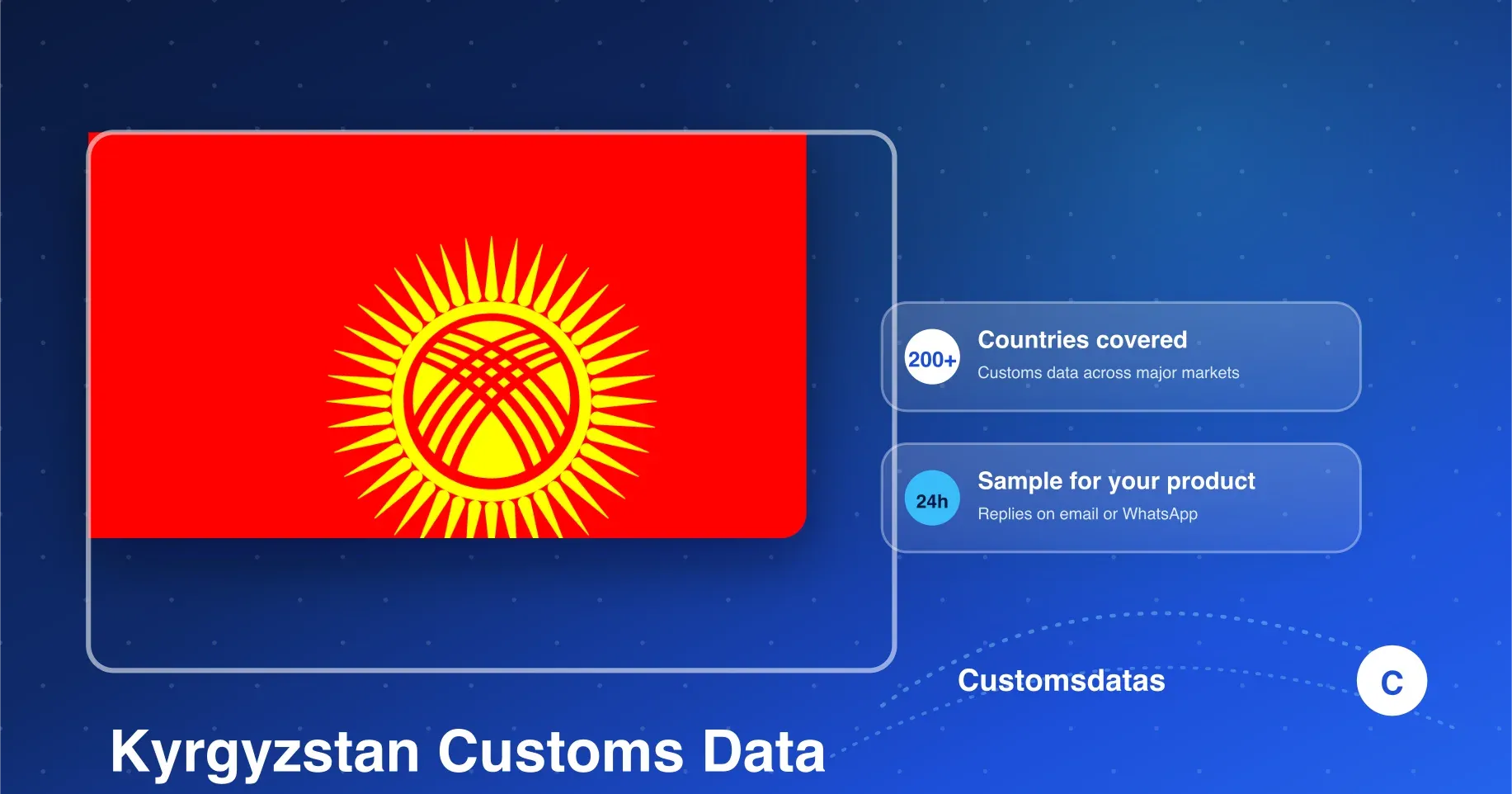
On Customsdatas, Kyrgyzstan holds a single trade layer and a notably full one: the field list carries exporters, product description, HS code, quantity, weight, value and brand on both sides; the records run in Russian; air freight is covered; and the update field reads none. For a landlocked market, that third fact — an air file — deserves more than a footnote.
When a country has no coastline of its own, a surface route crosses someone else's border before it reaches a shelf. Air freight is the corridor that skips the sequence. Reading this file well means reading the air lane as a route in its own right, not as a premium footnote to the surface trade.
Why the air lane earns first attention here
In coastal markets, air freight is an exception lane chosen for speed on a fraction of goods. In a landlocked market it plays a second role: it converts a multi-border journey into a single handover, which matters for more categories than pure urgency would explain.
That reframing changes who you expect to find on the lane. The usual picture is high-value, low-weight goods flown for urgency. A through-route picture adds businesses for whom air is not about urgency at all but about avoiding a chain of border crossings — a wider and more stable population than the emergency-shipper stereotype suggests.
A lane roster reads differently
Buyer tip: open your first search on the air lane alone. A lane roster read in isolation shows you the parties who have chosen the corridor deliberately — and deliberate corridor choice is one of the cleanest buying signals a file can show.
The parties on an air lane are not simply the busiest names from the general file re-sorted. Lane rosters skew toward categories where the through-route pays for itself: lighter goods, higher unit values, and businesses whose customers cannot wait out a border queue. Read the roster itself before comparing it to anything.
Where the lane and the surface list overlap
Overlap between the two rosters is the finding that pays. A name on both is a business that treats air as a standing option rather than an emergency; those names go to the top of the sheet, with the overlap recorded as the reason they rank there.
The comparison is cheap because it needs no new searches: draw the lane roster on one side of the page, the surface roster on the other, and mark the names that appear twice. The overlap group is usually small, and its smallness is what makes it useful.
Seven fields, mirrored
The declaration fields are complete — exporters, product description, HS code, quantity, weight, value and brand — and symmetric across directions, which lets one search produce two comparable party lists. Because records are in Russian, settle the term list once and reuse it: Russian product wording for the descriptions, and HS codes as the anchor that survives translation.
Brand names usually travel untranslated, which gives the term list a third stable layer: codes, brand names and a small set of Russian category words will carry most searches on their own.
Two speeds inside one category
Once the lane roster exists, keep it beside the general roster rather than merging them. The gap between the two is the reading: names present only on the lane are buying speed; names present only on the surface list are buying scale. Both are customers for different offers, and a merged list blurs the distinction the split just revealed.
Buyer tip: label every account with lane or surface before scoring. The label costs one word and prevents the most common mismatch in outreach — pitching speed economics at a scale buyer, or the reverse.
The cost of reading a photograph
The file does not refresh, so the lane roster is a dated photograph. That constraint bites less here than it would on a volume read: who chooses air is a structural fact about a business, and structural facts age more gracefully than shipment counts. Still, date every pull and treat the roster as current as of its photograph.
The photograph has a second use beyond its own date. If a later window arrives — or if a source with fresher records surfaces — the lane roster becomes a checklist: names to look up again, categories to re-open first, and a baseline that turns the next pull into a comparison instead of a rebuild.
A lane-first ranking
The output is compact: an air-lane roster with scale signatures, a surface roster for contrast, and the overlap group marked as priority. Every entry carries its direction, its signature and its lane status — four labels, no invented numbers.
The AI Buyer Discovery Suite takes this sheet next, running its modules over identification, activity and opportunity value, market recommendation, similar-buyer discovery, outreach lists with emails and WhatsApp contacts, and competitor buyer detection. Lane status gives the ranking its first honest sort; the suite refines from there.
Frequently Asked Questions
What does Kyrgyzstan's coverage list?
One trade layer on Customsdatas, complete on both sides: exporters, product description, HS code, quantity, weight, value and brand. The records run in Russian, air freight is covered, and no refresh is scheduled.
Why start from the air lane?
Because a landlocked market makes air a through-route rather than a luxury. The parties using it have made a deliberate routing decision, and that decision is readable in the file before any other signal is.
How do I build a lane roster?
Route your product line via the inquiry form or WhatsApp, and Kyrgyz records matched to it land inside 24 hours (Mon-Sat, GMT+8).
Want to see who moves your category through Kyrgyzstan's air lane? Request a free sample from Customsdatas and the lane roster comes back inside 24 hours.