Sep 23, 2026Market Analysis
HS 84213100 Air Intake Filters: Reading the Export Market in Data
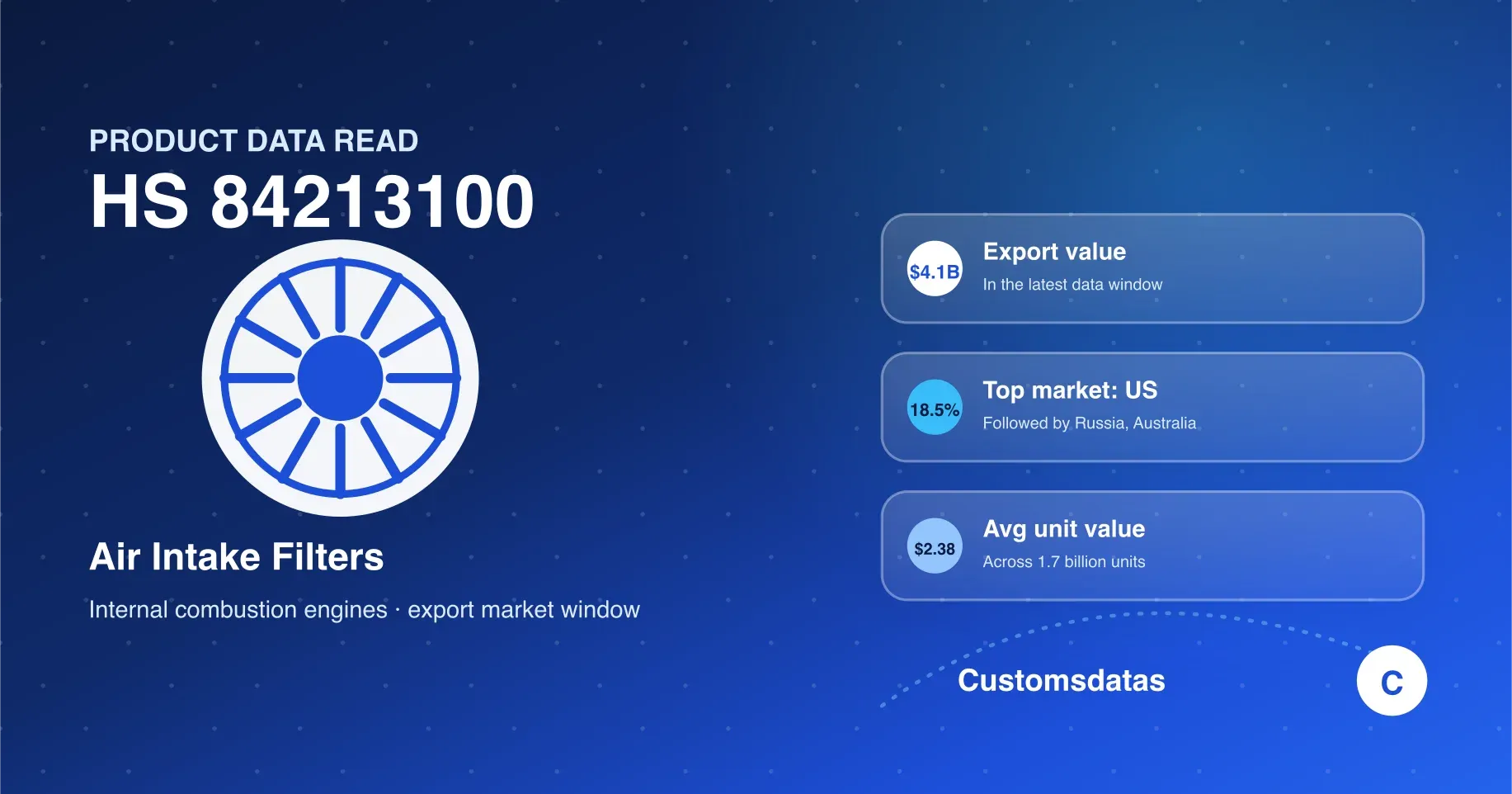
A product-level data read for HS 84213100 — engine intake air filters: $4.08B in a window, top markets led by the US at 18.5%, and a supply side concentrated in six hubs.
Most customs data searches start with a market and end with a category. This one starts with the product itself — HS 84213100, intake air filters for internal combustion engines — and reads the whole picture the code opens up: how much moves, where it goes, and who supplies it.
Product-level reads like this are the fastest way to judge a niche. Instead of asking whether a market wants your category in the abstract, you look at the code your product actually travels under and let the record stack answer with numbers.
What HS 84213100 covers
Heading 8421 covers filtering and purifying machinery. The subheading 84213100 narrows to intake air filters built for internal combustion engines — the filters that sit between the intake and the engine, protecting it from dust and debris. It is a component category: steady replacement demand, spread across vehicles, generators, agricultural machinery and industrial equipment.
For data work, the code is the key. Products cross borders under classification, not under marketing language — so the code is both your search term and your market definition. Get it right and every qualification step downstream inherits the precision.
The size of the window
In the latest reporting window on our platform, exports under HS 84213100 totalled about $4.08 billion across roughly 1.71 billion units, at an average unit value of about $2.38. Two readings stand out. First, the unit count is enormous — this is a volume business, and the average value per piece reflects commodity pricing at scale. Second, that average is a benchmark: if your own product sits well above or below it, you are playing a different positioning game than the category's midpoint.
Buyer tip: treat the average unit value as your first sanity check. A mismatch of multiples usually means a different sub-segment, not a pricing mistake — and it deserves its own code-level search.
Where the product goes
The destination map is led by the United States at 18.47% of export value — about $753 million, and the single largest national market by a wide margin. Russia follows at 8.98% (about $366 million), then Australia at 4.47%, Germany at 3.03%, Japan at 2.79%, Kazakhstan at 2.67%, Singapore at 2.57% and Brazil at 2.53%.
The shape of that list rewards attention. It is not a story of one buyer world; it is heavy vehicles, industrial equipment and replacement-part channels across very different regulatory environments — North America at the top, then a spread of European, Asian and Latin American markets, each substantial enough to justify its own outreach list.
Buyer tip: a destination list this broad usually means the product is channel-driven, not end-user-driven. Filter importers, parts distributors and aftermarket wholesalers are the accounts to look for first.
Who supplies it
The supply side is sharply concentrated. In the same window, Zhejiang alone accounted for 21.23% of the flows — about $866 million — followed by Hebei at 14.99%, Guangdong at 11.83%, Shandong at 9.54%, Jiangsu at 8.14% and Shanghai at 7.16%. Six hubs together account for more than 70% of the supply.
For sourcing professionals, that concentration is the headline: this is a category where a handful of manufacturing clusters control most of the export volume. For sellers outside those hubs, it defines the competitive field they are stepping into.
The rhythm of the year
Across the most recent ten reporting months, monthly flows ran from roughly $42 million to about $69 million — a swing of over 50% between that stretch's low and high. A range like that is not noise; it is the signature of seasonal demand cycles in replacement parts and equipment manufacturing, and it moves the leverage in negotiations depending on when you buy or sell.
Buyer tip: line the monthly curve up against your own capacity before setting quotes. A seasonal category rewards sellers who can hold inventory through the trough and buyers who can commit at the bottom of the cycle.
Running the same read on your own product
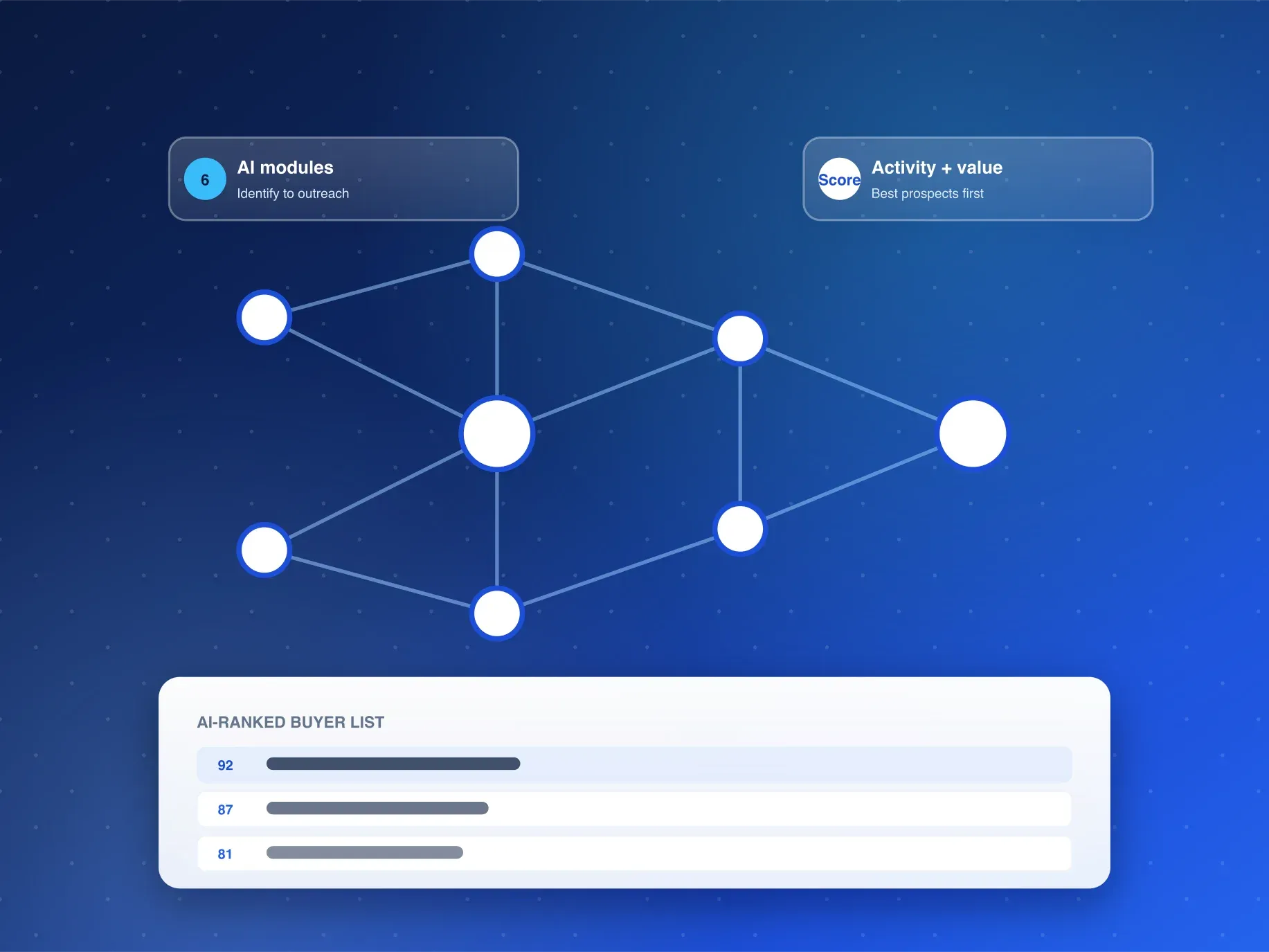
Everything above comes from one product-level query, and the same read works for any code: confirm the classification, pull the trade window, map destinations to size the buyer pool, check the supplier concentration, and read the monthly rhythm for timing. Then request samples for the specific parties behind the records and move into outreach with a scored list — the AI Buyer Discovery Suite handles the scoring and contact-list generation on the platform side.
The difference between this and a market report bought off the shelf is that you run it on your code, on your window, whenever your assumptions change. That is the point of product-level data reads: they are a habit, not a purchase.
One more habit worth building: save each read with its date. Product windows move, and the value of your archive compounds — six months from now, a snapshot from today becomes the comparison base that shows which markets grew and which drifted. The records are the same; the trend only exists if someone kept the earlier page.
Frequently Asked Questions
What is HS code 84213100?
84213100 covers intake air filters for internal combustion engines — the filtering component fitted ahead of the engine intake. It sits under heading 8421, filtering and purifying machinery for liquids and gases.
Where can I find buyers for air filters?
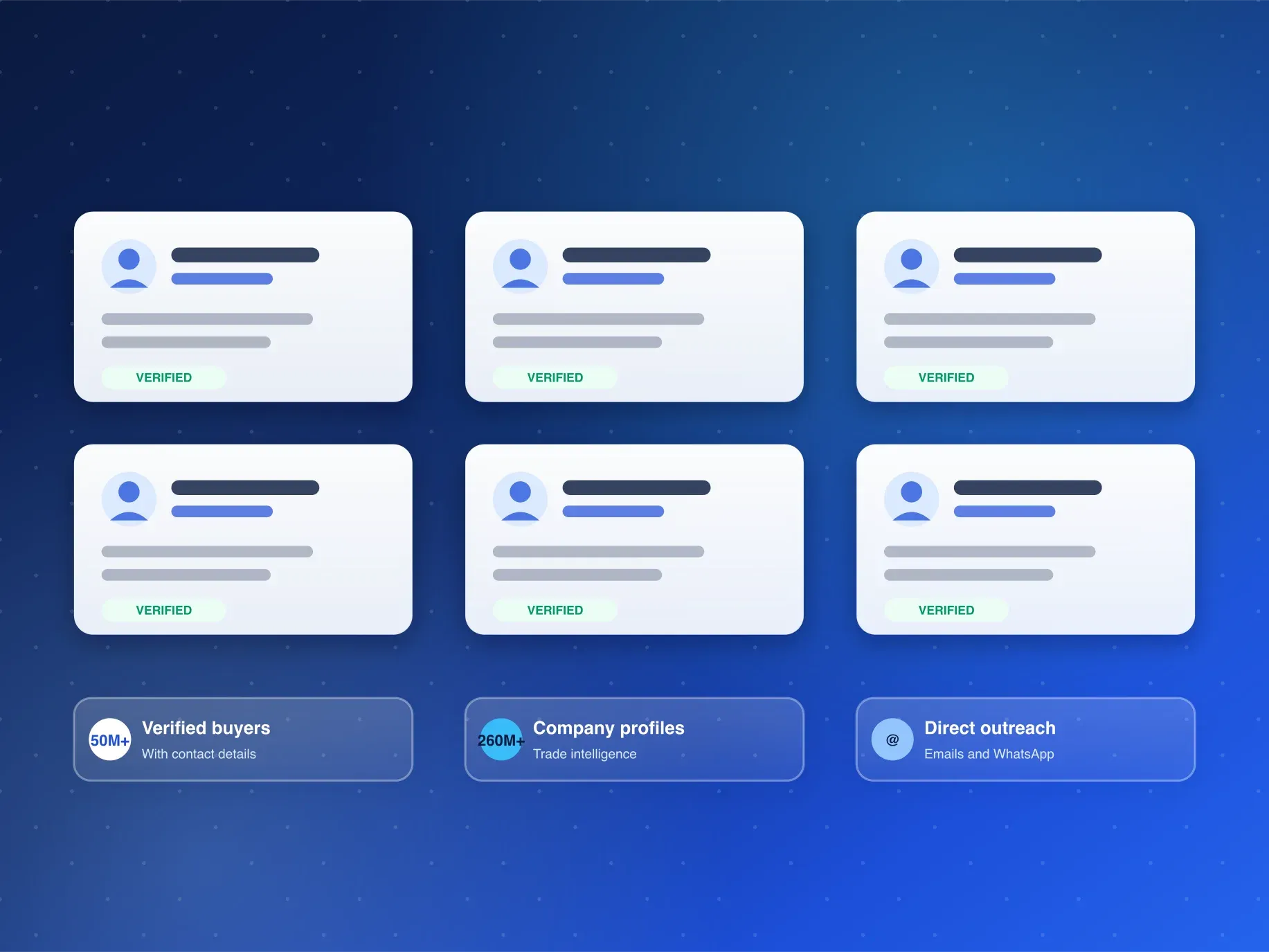
Start from the code: pull HS 84213100 records and rank importers by recurrence to separate steady buyers from one-off purchases. The platform's buyer discovery tools can then score those accounts and generate contact lists with verified emails and WhatsApp details.
How do I run this read on my own product?
Request a free sample through the inquiry form or WhatsApp and send your product or code. The team replies within 24 hours (Mon-Sat, GMT+8) with the records, and you can walk the same five steps on your own category.
Want to open the same window on your product? Request a free sample from Customsdatas — send your HS code and see the market read within 24 hours.