Sep 29, 2026Country Guides
Honduras Customs Data (2026): Reading Alignment Between the Two Directions
Both directions carry the same six fields, so the same product can be followed on both sides. How to read alignment — and what it does and does not prove.
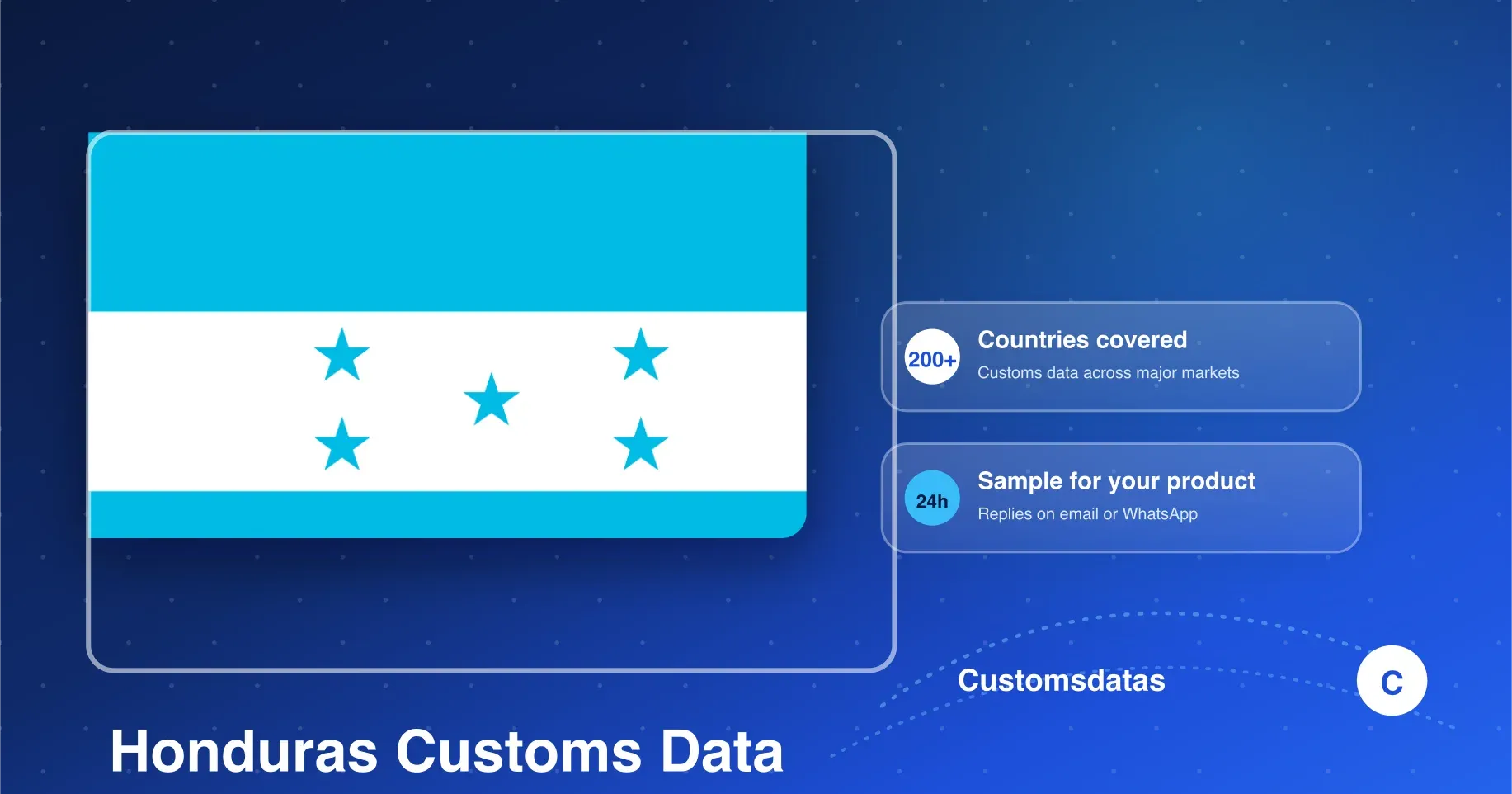
Honduras appears on Customsdatas with matching field sets on both sides: imports and exports each carry exporters, product description, HS code, quantity, weight and value. Those records are in English, air freight is included, and the file does not refresh on a schedule.
The interesting property of a symmetric file is what it lets you see between the sides. When the same product appears in both directions, that pattern is a signature — of processing, of re-export, of regional distribution — and learning to read it separates a market's end demand from its pass-through traffic.
One product, two windows
With identical field sets, the two directions of a category can be laid side by side without translating anything. Start with your product's descriptions and codes on the import side, then run the same search on the export side and compare the two result sets party by party, code by code.
What you are looking for is overlap. A code that appears in both directions in real volume says the market handles this good in both roles — which is normal in an economy that assembles, processes or redistributes, and which changes who your buyer is.
Spotting pass-through trade
Pass-through trade leaves a recognisable shape: the same codes on both sides, parties that appear in matched positions across the two windows, and quantities that scale together. None of these patterns is proof on its own, but two or three together make a working hypothesis worth testing in the first conversation.
Buyer tip: when a party appears on both sides of one category, do not assume it is your customer and do not assume it is your competitor. Write down the question instead — and let the first exchange settle which role the business actually plays.
What alignment does not prove
Alignment is a signal about structure, not about intent. A matching pair of flows can be a processor feeding its own line, a distributor moving goods inland, or two unrelated businesses that happen to share a code. The symmetric fields describe the movement; they do not label the business model.
The discipline is to rank by evidence rather than by story. A party visible on one side only is a straightforward account. A party visible on both sides is an intelligence item: worth more attention, but also worth more verification before any pitch is written.
Working the six fields on both sides
The field set is identical on both sides, so the analytical routine is too. Description and code define the category; quantity, weight and value give it scale and texture; the exporter field attaches a name. Run the routine once per side, then merge the two outputs into a single category view.
Buyer tip: keep the merged view in two columns — inbound and outbound — rather than one long list. The pairing is the analysis here, and a flat list throws it away.
Because the coding is identical on both sides, a single search term returns a clean set from each window. Run the same term twice, then read the two result sets as one document; the only differences you will see are the actual differences in the trade, which is precisely the point of working a symmetric file.
The air layer as a check
Air freight coverage adds a second channel to the same census. For lighter or higher-value categories, the air lanes often carry a different set of parties than the sea lanes, so the two channels together give a fuller roster than either alone would suggest.
Sizing the intermediary share
A worked comparison makes this concrete. Run the same code on both sides of the file and count the distinct parties on each. If the outbound roster names thirty businesses and the inbound roster names three, the market's structure is a few large handlers downstream of many suppliers — and a first letter to a handler will out-perform any list built from the suppliers' side.
Once the two sides are mapped, the ratio between them is itself a reading: a category with many more outbound names than inbound ones suggests a hub-and-spoke structure around a few large handlers, while a balanced pair of rosters suggests a two-way market of independent traders.
Neither shape is better. They call for different first letters — the concentrated version rewards approaching the handlers, the balanced version rewards breadth of outreach — and knowing which you are looking at is the entire point of mapping both sides.
From the merged view to two shortlists
From the merged view, build two shortlists rather than one: single-side accounts, which are simple to approach, and dual-side accounts, which carry more information and deserve the first calls. Rank within each list, because the two groups are not comparable on a single scale.
The AI Buyer Discovery Suite then runs the scoring and contact pass, module by module: identification, activity and opportunity value, market recommendation, similar-buyer discovery, outreach lists with emails and WhatsApp contacts, and competitor buyer detection. It works best fed with the separated lists, where the role of each party is already written down.
Frequently Asked Questions
What fields does Honduras' coverage list?
Both directions carry the full set — exporters, product description, HS code — with quantity, weight and value alongside. The coverage is in English, air freight is part of it, and the file carries no regular update.
Why compare the two directions instead of reading one?
Because with matching field sets the comparison is free and it is informative: overlap between the sides is what distinguishes end demand from pass-through handling, and that distinction decides who you approach and how.
How do I run the two-sided read on my category?
Send your category through the inquiry form or WhatsApp and ask for the two-sided view. Honduran records with both directions arrive inside 24 hours (Mon-Sat, GMT+8).
Want to see both sides of your category lined up in one view? Request a free sample from Customsdatas and align both sides of the file within 24 hours.