Oct 16, 2026Guides
From Customs Data to a Conclusion: The Three-Read Method
Records answer search queries; analysis answers business questions. The bridge is three reads — grouping, rhythm, trend — each one turning observations into a judgment you can act on.
Searching customs data and analysing it are different skills, and the gap between them is where most read-outs go soft. A search returns rows; an analysis returns a judgment you can act on. The bridge is a small set of reading moves — grouping, rhythm, trend — applied in order, with the discipline that each read produces its own kind of claim and no read is allowed to make the next one's.
This guide sets out the three reads and the separation rule between them. It is the companion to the five search dimensions covered elsewhere on this site: that guide is about how to ask the file a question, this one is about what to do with the answer.
One rule before the three reads
Every analysis mistake worth avoiding is a crossing of levels. A single observation — this buyer appeared this month — is not a rhythm. A rhythm across two windows is not a trend. Each level of claim needs its own evidence, and the discipline that keeps them separate is the entire method in one sentence: read, then decide what the read licenses, then state only that.
Buyer tip: write observations and interpretations in different columns. The moment they blur into one column, every downstream decision inherits the blur — and the first colleague who asks for evidence will find the sheet unable to answer.
Read one: grouping
Grouping is the first read because it creates the units everything later measures. The raw rows group by party, by category, by scale band, by origin — and the grouping you choose is a hypothesis about where the market's structure lives. Group badly and the later reads measure the wrong thing; group well and the structure announces itself.
The grouping read answers: who is in this market, in which roles, and how does the trade cluster? Its claim is a structure — a map of participants — and nothing more. A map is not yet a recommendation; it is the surface the next reads walk on.
A practical note on grouping scale: bands are better than exact numbers. Grouping participants into scale bands — small, mid, large — instead of ranking by precise volumes keeps the read robust against the noise any single record carries, and it is what lets a group map survive a colleague's cross-examination.
Read two: rhythm
Rhythm is the read that turns a structure into behaviour: how often each participant moves, with what regularity, in what cadence. A party moving monthly is a different business from one moving annually, and the difference is visible in the spacing of its rows. Rhythm is where boring rows become informative — the steady participant is exactly the one the eye slides past.
The rhythm read's claim is behavioural: this is how the market's participants actually operate. It licenses prioritisation — who deserves a first conversation — but not yet the market-level judgment that trend provides.
Rhythm also carries the seasonality signal that grouping cannot: the same annual volume can mean a monthly rhythm or a two-month burst, and the two call for opposite outreach timing. Reading the spacing, not just the total, is what the rhythm read exists for.
Third read: the direction across time
Trend is the read across time horizons: what is growing, what is flattening, what is tapering. It needs the longest window of the three and is the most patient claim — a trend read after two data points is a rhythm wearing a trend's clothing. The honest trend statement names its window and its direction, and resists the temptation to project the line forward past what the data shows.
The trend read's claim is directional: where the market is heading. It licenses strategy — enter, hold, deprioritise — and it is the only one of the three reads that does. Strategy built on grouping alone is a bet on a photograph; built on trend, it is a bet on a trajectory.
The honest trend statement also carries its own horizon: what this window shows, not what the next year will bring. Projecting past the data is the one failure the three reads cannot absorb, because the other two reads will happily build on a projected trend as if it were an observed one.
Buyer tip: keep the three reads in separate tabs of one sheet. Structure, rhythm and trend each get their own tab and their own date; then a judgment cites the tab it came from, and the separation rule survives contact with a live spreadsheet.
From three reads to one judgment
The three reads stack: the structure defines who is present, the rhythm shows who is alive, the trend shows where the whole is heading. A judgment worth acting on — this category deserves a campaign, this account deserves a first letter, this market deserves a pause — is the one that can trace itself back through all three. A judgment that skips a read announces the skip, and the skip is where bad campaigns are born.
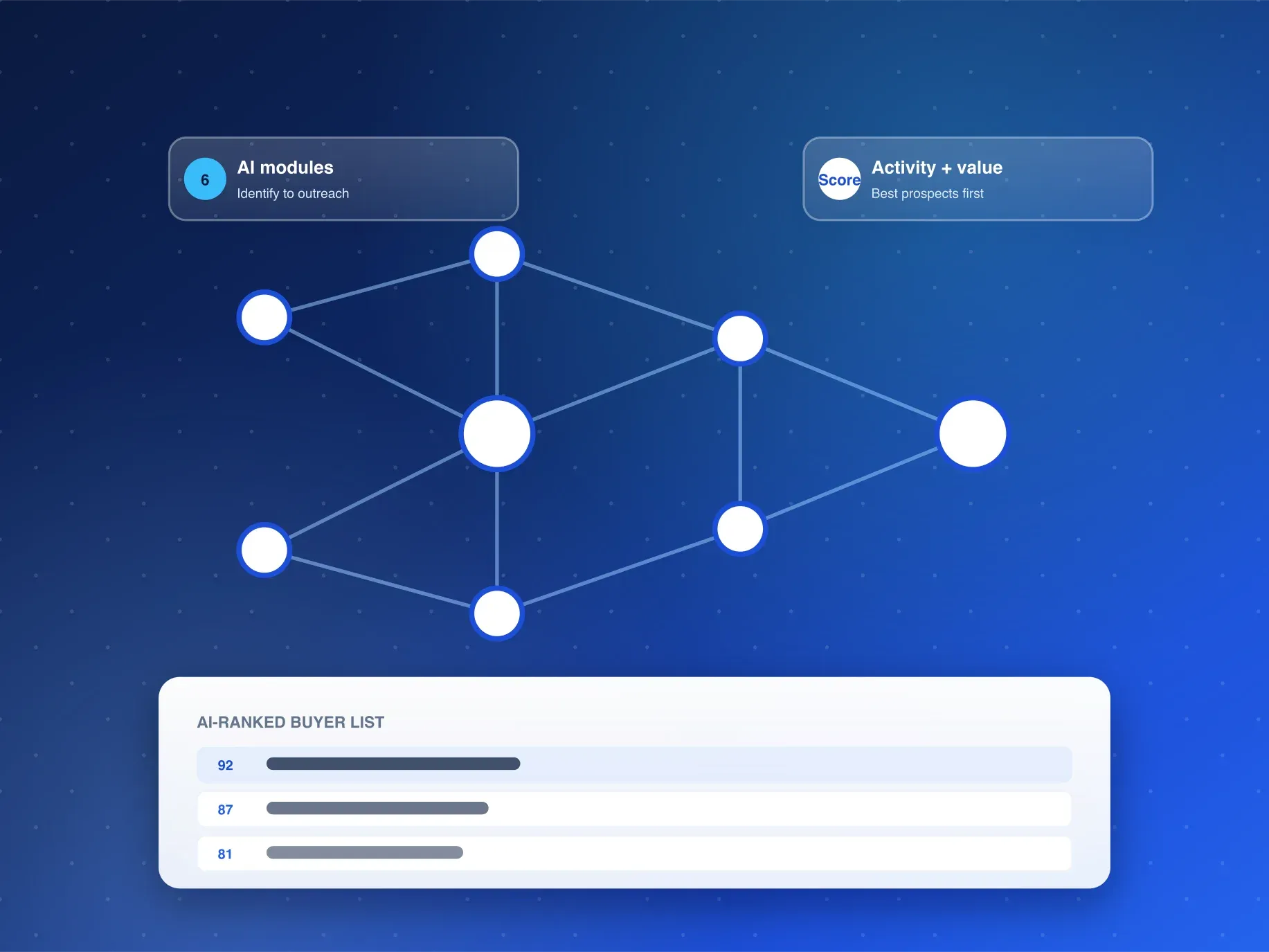
And where the judgment is ready, the automation takes over: the AI Buyer Discovery Suite then runs its six modules — identification, activity and opportunity value, market recommendation, similar-buyer discovery, outreach lists with emails and WhatsApp contacts, and competitor buyer detection — across a market whose structure, rhythm and trend are already on the page.
Frequently Asked Questions
What is the difference between searching and analysing?
Searching asks the file for rows; analysing turns rows into a judgment. The bridge is the three reads — grouping, rhythm, trend — each with its own claim and its own evidence.
How much data does a trend read need?
More than two windows — long enough for the direction to outlast its own wobbles. A trend statement that names its window is honest; one that does not is a rhythm in disguise.
How do I practice the three reads on my market?
Put your product line in the message through the inquiry form or WhatsApp; your sample comes through within 24 hours (Mon-Sat, GMT+8).
Want the three reads demonstrated on your own product? Send it to Customsdatas for a free sample and work the reads on real records within 24 hours.