Oct 19, 2026Guides
Before You Write: A Fifteen-Minute Company Check
A business card or a record gives you a name. Fifteen minutes of checks on the company itself — not the record — decides whether the name deserves a letter.
Sooner or later, a sourcing routine produces the same moment: a name in hand from a business card, a record, or a directory, and a decision about whether to write. In practice the check is either skipped entirely or stretched into an afternoon. Fifteen minutes is enough — not to know the whole picture, but to know whether the company is real, what it does, whether it trades, and whether anything about it should stop you.
These are company-level checks, and they are deliberately not the record-level screens used to triage a single movement. A record tells you what a company did once; a company check tells you what kind of business you are about to approach. The two use different evidence and answer different questions. Keeping them separate is what stops a company check from turning into a second pass over the same record.
Check one: is the legal entity real?
Start with existence, because the other checks assume a company exists. The check is a company register, a business registration lookup, or the company's own site with consistent details — legal name, registration number where published, address, and contact details that match across sources. A website alone is weak evidence; a register plus a website that agree is strong.
Buyer tip: compare the exact spelling of the name across sources. Variants are normal — trading names differ from registered names — but a name that appears in only one document deserves suspicion before enthusiasm.
Check two: the company's own account of itself
The second check is scope: how large is the business and what role does it play in the chain. The question is the company's standing, not its part in any single movement. Size signals come from the company's own materials (facilities, staff, years active) and should be read as claims until something corroborates them. Role signals come from language: manufacturer, importer, distributor, trading house, service provider. Read that label as the company's own claim, then check whether the rest of the profile fits it.
Check three: does it trade at all?
The third check is the one that separates a plausible company from a plausible customer: evidence that it actually trades the goods in question. Trade records are the clearest source where the market publishes them — a company with visible movement in your category has passed a test a website cannot provide. Where records are unavailable, the fallback is indirect: product pages, market presence, certifications, references — weaker, and to be treated as such.
Buyer tip: keep the evidence and the claim separate. A company claiming to import your category and a company shown importing it are different kinds of facts, and a letter that treats them as equal will read like a template.
Check four: reasons to stop
The last check is subtraction: anything that should stop you before a letter. Contradictions between the company's own sources — an address that does not match, a registration that cannot be found, a website with no trace of the business — are the clearest kind. Dormant activity is another: a company whose visible trade stopped long ago may still be worth a question, but not worth a campaign.
A quarter-hour routine
The four checks fit a quarter of an hour when run in this order: register and site (five minutes), role and size from the company's own description (three), trade evidence from records or indirect sources (five), and a two-minute stop-signal review. The order is deliberate — each check either strengthens or weakens the next, and the stop-signal review is last because it reads the earlier checks together.
Buyer tip: keep a one-line note per company — name, role, evidence, verdict. After a dozen, the notes become a pattern of which sources are reliable in your market, and the fifteen minutes start shrinking.
When to hand the check to a tool
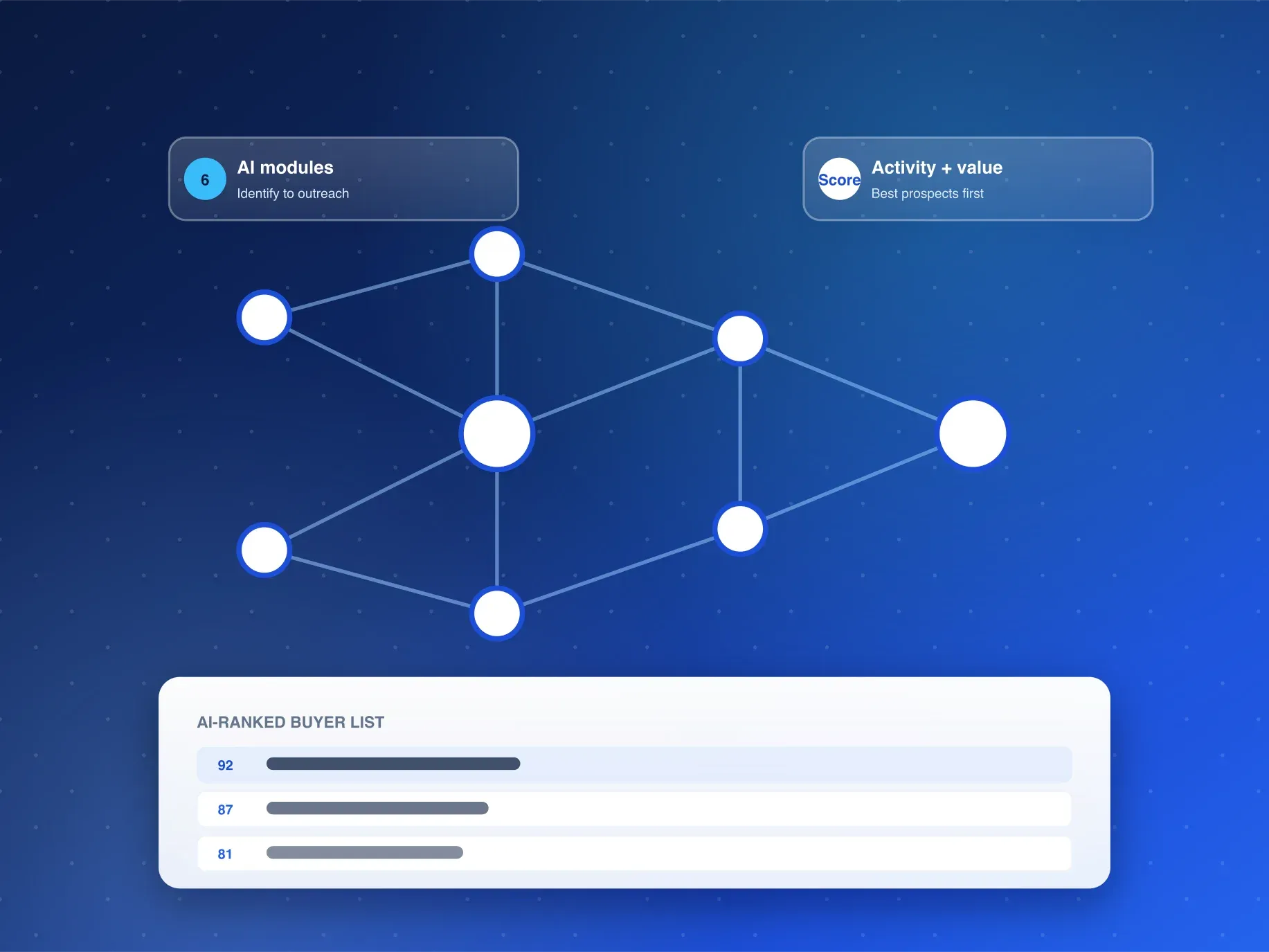
The check is cheap enough to do by hand for a handful of names and expensive enough to matter at volume. At volume, parts of it can be delegated: the AI Buyer Discovery Suite runs its six modules — identification, activity and opportunity value, market recommendation, similar-buyer discovery, outreach lists with emails and WhatsApp contacts, and competitor buyer detection — covering the identification and activity portions; the final stop-signal judgment still belongs to a person.
Wherever the checks run, the output format should stay the same: one line per company, evidence separated from claims, verdict stated. That format is what makes the fifteen minutes reusable — a check written as a paragraph is gone the moment the quarter ends.
One final habit that keeps the check cheap: keep the four checks in a fixed order and stop at the first hard stop. A failed entity check ends the check at minute five, and the minutes saved by not finishing are the difference between a routine that survives a busy week and one that gets abandoned.
Frequently Asked Questions
Is a website enough to verify a company?
No. A website is a claim, not evidence. The check pairs it with a registration source and, where available, trade records — the agreement between independent sources is what makes a company real for practical purposes.
What if no trade records exist for the company?
Then the evidence check falls back to indirect signals — product pages, market presence, references — and the verdict should say so. A company with no visible trade is not disqualified, but it is unproven, and a letter to it should be framed as an inquiry rather than a pitch.
How do I run the check against my market?
Start with a sample for your category: send the product line by the inquiry form or WhatsApp, and an answer comes back inside a day (Mon-Sat, GMT+8) with records to check. Read the trade evidence first.
Fifteen minutes before the letter is cheaper than a misdirected one. Ask Customsdatas for a free sample and run the four checks on records for your own category.