Country Guides
Ethiopia Customs Data (2026): Compare Both Trade Directions Without Inventing Product Descriptions
Compare Ethiopia import and export records using the six confirmed fields while avoiding invented product descriptions, unsupported unit prices, and assumed data freshness.
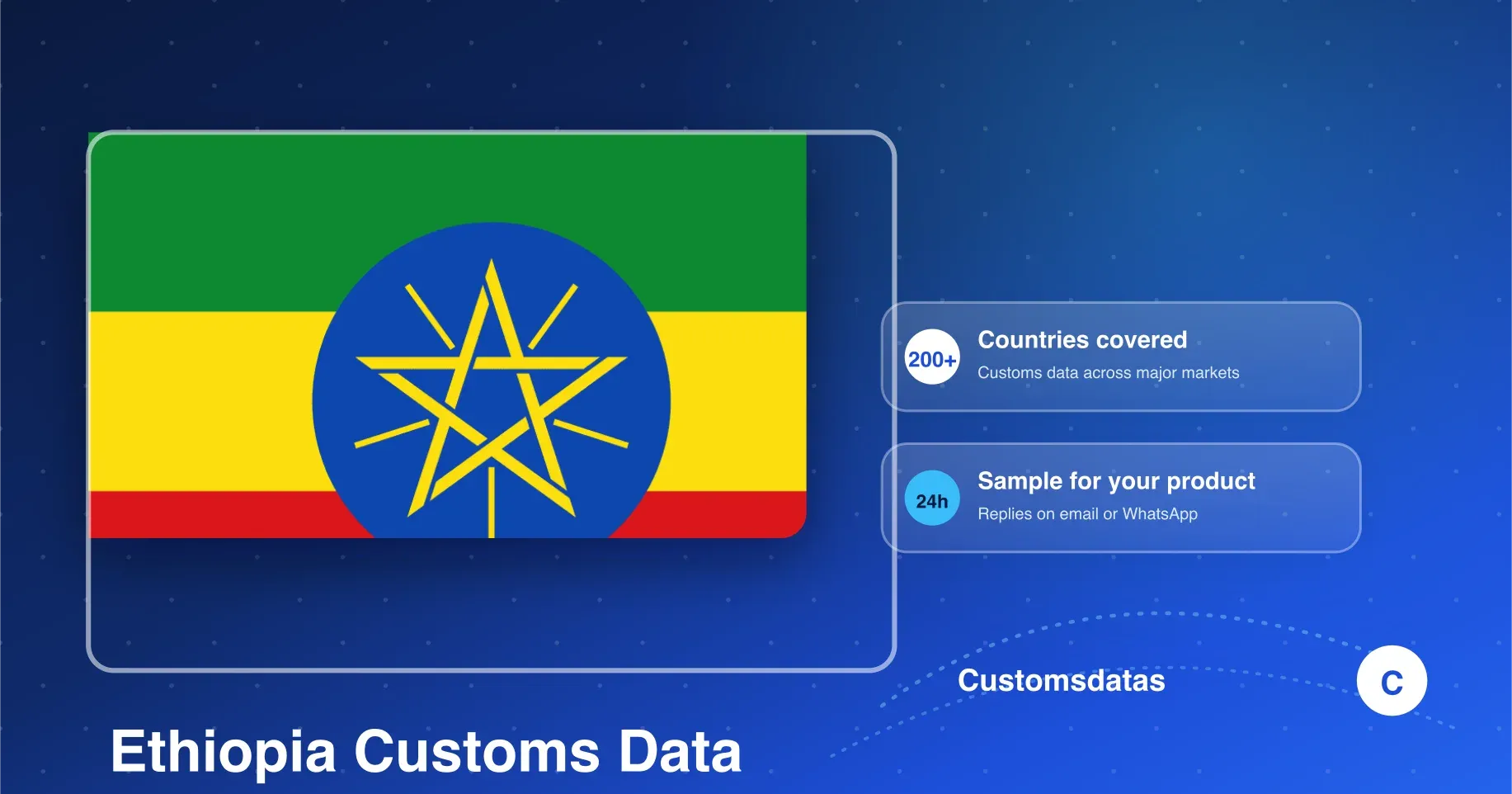
Ethiopia customs data presents a useful but easily misunderstood research pattern. The Customsdatas country matrix identifies trade data and lists the same six fields for import and export directions: exporters, HS code, quantity, weight, value and brand. It does not list a product-description field for either direction. The central task is therefore to compare structured signals while resisting the urge to turn classification codes into detailed product narratives.
This matters for teams screening potential trading partners. A named exporter and an HS code can support a first-pass investigation, but neither establishes what exact item was shipped or whether the company can supply a particular specification today. The best research process preserves the boundary between observed fields, analyst interpretation and external verification.
Use a two-direction comparison, not a single merged table
Create separate import and export views before attempting a combined analysis. In each view, retain the original direction, exporter name, HS code, quantity, weight, value and brand. A row's direction is part of its meaning; dropping that column can make two distinct trading activities appear equivalent. Keep dates and filters with the source extract.
The fact that both directions list the same field names does not prove identical coverage, row counts or completeness. Sample each direction independently. If one side has more missing brand entries or fewer usable company names, report that observed difference rather than assuming the source matrix promises symmetrical results in practice.
Treat HS codes as a classification doorway
An HS code provides a way to group and investigate goods, but it does not replace an item description, technical specification or commercial invoice. Ethiopia's confirmed field list does not include product descriptions. Avoid writing detailed product names into an exported report as though they came from the underlying record. Label any interpretation as an analyst-added category.
A practical approach is to start with a defined code family, inspect a handful of rows and then cross-check the code interpretation against an appropriate tariff reference. Different levels of code detail can change the precision of a category. Keep the original code unchanged so that later reviewers can audit the mapping.
Reconcile numeric fields before ranking companies
Quantity, weight and value are all listed in both directions, which makes numerical comparison possible in principle. However, a division of value by quantity is meaningful only after checking currency, measurement units and valuation basis. Weight may also need a gross-versus-net distinction. Do not publish derived unit prices without recording these assumptions.
For screening, compare ranges rather than declaring that the largest value belongs to the best supplier. A high-value row may reflect different goods, shipment size or reporting conventions. An outlier is a reason to inspect supporting fields and sampling conditions, not a standalone signal of commercial reliability.
Keep brand evidence separate from ownership claims
The brand field can help analysts prioritize records, but its presence does not prove that an exporter owns the brand or has a distribution agreement. A brand name may be recorded inconsistently across shipments. Store raw strings and normalized variants in separate columns, and mark uncertain matches for manual review.
When matching a company across import and export directions, do not assume identical spellings identify the same legal entity. Use external registration details, official websites or direct correspondence to verify identity. The customs-data stage should produce a traceable hypothesis, not an unqualified statement about corporate relationships.
Design an audit around what is missing
Because product descriptions are not confirmed for Ethiopia in either direction, the absence should be explicit in the research brief. Write a field-availability note beside every chart or lead list that relies on HS codes. This is particularly important when stakeholders expect detailed product intelligence from a country report.
If exact products are essential, request a representative sample and inspect whether additional details appear in the current interface or supporting documents. Until that evidence exists, phrase findings at the classification level. The discipline protects both the analyst and the reader from overinterpreting an apparently precise dataset.
Check operational coverage on the actual sample
The Ethiopia profile marks English as the language and air data and updates as available. These flags should guide a test plan, not become a blanket claim that every air shipment is included or every record is newly refreshed. Inspect the date range, transport filter and returned fields for the actual query.
Record the latest observed date separately for import and export samples. If the dates differ, do not collapse them into one freshness statement. A small documented sample can reveal whether the chosen code family is suitable for research before a team invests in broader extraction or repeated searches.
Produce a defensible partner-screening handoff
A useful Ethiopia output includes two direction-specific tables, a code interpretation glossary, unit and value caveats, and a short list of companies needing identity checks. Each recommendation should point back to an observable record and explain why the company warrants further investigation. Keep unknowns visible rather than smoothing them away.
For an exporter exploring opportunities, the results may suggest which code categories deserve market research, but they cannot prove current purchasing demand. For procurement teams, they can prioritize outreach candidates, but not certify production capacity. Make those boundaries part of the deliverable rather than an afterthought.
Turn the comparison into a repeatable decision
Use a consistent sequence: define the business question, sample each direction, audit the six confirmed fields, check missingness, validate classification interpretation, then verify company identities independently. Review exceptions before expanding the query. This order prevents a large extract from masking basic misunderstandings about the available evidence.
Customsdatas can support this investigation through its trade-data workflow. The strongest outcome is not a promise of perfect Ethiopia coverage; it is a clear record of what was inspected, what the fields actually support and what must still be confirmed with the prospective partner.
FAQ: Does Ethiopia customs data include product descriptions?
The current country matrix does not confirm a product-description field in either import or export direction. It lists HS codes, but those are classification signals rather than detailed descriptions of individual products. Verify a live sample before claiming additional detail.
FAQ: Can I compare Ethiopia imports and exports directly?
You can design a comparison because both directions list exporter, HS code, quantity, weight, value and brand. First test each direction separately and reconcile units, date ranges and missing fields. Matching column names do not guarantee matching record coverage.
FAQ: Does the update flag mean today's records are available?
No. The profile indicates updates are available, not that every record is current to the day. Inspect visible record dates and the query's coverage before describing freshness or making time-sensitive decisions.
Explore Ethiopia customs data on Customsdatas and request a direction-specific sample. Ask the team to confirm the fields, dates and code granularity needed for your research before treating a candidate list as a verified supplier directory.