Sep 23, 2026Country Guides
Dominican Republic Customs Data (2026): Working a NEW Market Before the Field Notices
The Dominican Republic is newly covered on Customsdatas: trade plus statistics. How to screen, verify and move on a freshly opened market.
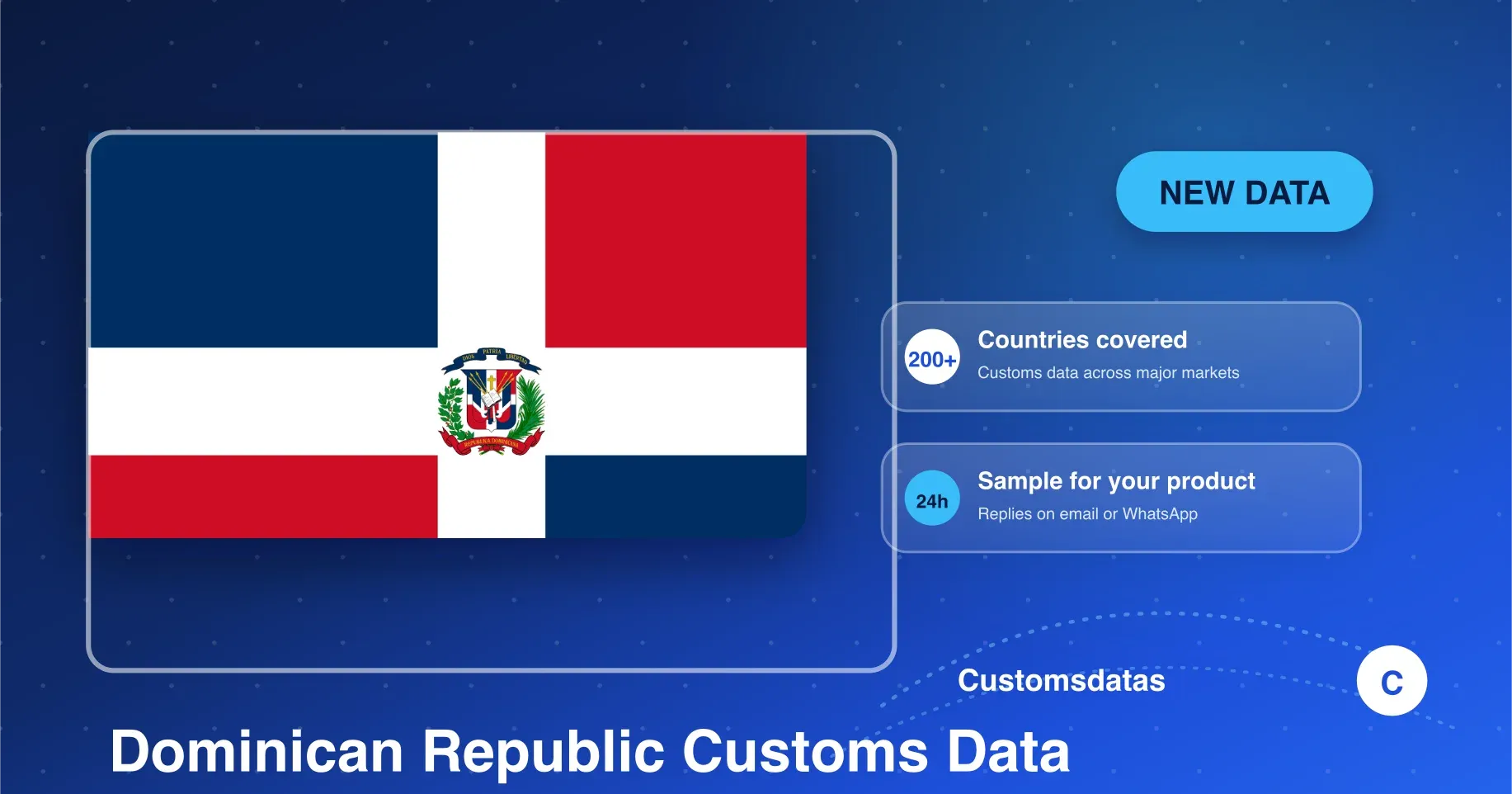
The Dominican Republic carries a NEW flag on Customsdatas: recently added coverage, running on trade declarations plus a statistics layer. For teams that judge markets by competition for attention as much as by size, a NEW market is a specific kind of opportunity — the data is open, and most of your competitors do not know it yet.
This guide is about how to work a newly covered market properly: screening it with the statistics layer, verifying with the declarations, and moving on the window before it closes.
What a NEW flag actually signals
The flag marks newly available coverage, not a new market — the Dominican Republic has been trading with the world for centuries. What is new is the visibility: buyers and flows that were previously opaque now appear in searchable records. Early users of a newly covered market see something later entrants do not — an uncrowded shortlist.
That head start has a shelf life. As coverage becomes known, outreach density into the same buyer pool rises. The practical consequence: act on new coverage when your category is ready, not when it is convenient.
Screening with statistics first
The statistics layer is the efficient way to decide whether a compact Caribbean market deserves your effort. Pull your category's trade trend and size, and answer three questions in sequence: is the category importing at all, is the flow stable or moving, and is the value concentration high enough to support a focused list?
A compact market passes this screen in an afternoon, and it fails just as quickly — which is the point. The statistics layer is a filter, not a research project, and its job is to protect you from building buyer lists for categories that cannot carry them.
Buyer tip: for small markets, judge on value concentration rather than total volume. A narrow category with concentrated import value is a workable target list; broad low-value flows are usually someone else's business.
Verifying with the declaration window
Once the statistics pass, the trade declarations confirm the market in names. The platform's coverage for the Dominican Republic runs on trade data, and which columns your product line responds to is confirmed on a sample run — real records teach you the searchable vocabulary the market actually uses.
In compact markets, the buyer pool is small enough to work account by account, which changes the discipline: depth beats breadth. Read each candidate's record history properly rather than running long keyword sweeps — in a market this size, twenty well-read accounts can be the whole target list.
Buyer tip: treat every qualified Dominican importer as a relationship rather than a lead. Small market lists run out quickly, so the account worth keeping beats the list worth growing.
How few channels carry the trade
Island economies of this scale tend to concentrate trade in a limited number of import channels, and the Dominican Republic's position — close to North American supply lines with its own demand base — suggests flows that cluster around a manageable set of recurring buyers.
The practical read is encouraging for focused sellers: fewer channels means less dilution of your outreach, and a clear answer to who the category gatekeepers are. If your product competes at all in the Caribbean basin, ten well-qualified local accounts can be a market presence rather than a test.
Why early coverage pays twice
New coverage pays twice because of what it changes on both sides of the table. On your side, the buyer pool is uncrowded — the same records that everyone will eventually have are, for now, mostly unworked. On the buyer's side, a first contact that cites their own declared import pattern is rare, because most suppliers still approach Caribbean markets with generic lists. The window closes when both sides become common knowledge.
Buyer tip: when you open the Dominican Republic, log the date of your first qualified shortlist. Rebuild it after each refresh of the coverage, and the delta between versions shows you both the market's movement and how quickly the window is filling.
Timing and follow-through
New coverage rewards a deliberate first move: pick the category, build the shortlist from the two layers, and open conversations within the quarter. The window is widest now, while the records are fresher to you than to the field.
When the list is ready, the AI Buyer Discovery Suite runs the scoring pass and builds the contact list — emails and WhatsApp — with the similar-buyer module ready to widen the pool if the first conversations suggest the market is bigger than the visible records.
Set a review date when you build the shortlist — ninety days is a reasonable default. Compact markets move in visible steps, and a scheduled re-read of the same category tells you whether early conversations are landing: the parties that move up in the records after your first outreach are the clearest signal a small market can send.
Frequently Asked Questions
What does the NEW flag on the Dominican Republic mean?
It marks recently added coverage on the platform: trade declarations plus a statistics layer. The market itself is long established — what is new is that its flows and parties are now searchable here.
Which record layers are available for the Dominican Republic?
Trade data and statistics. Use the statistics layer to screen the category and the trade records to build and verify the buyer list.
How do I get samples?
Request a free sample through the inquiry form or WhatsApp. The Customsdatas team replies within 24 hours (Mon-Sat, GMT+8) with records for your product line.
Ready to look at a NEW market before the field notices? Request a free sample from Customsdatas and see the Dominican Republic data within 24 hours.