Oct 12, 2026Guides
What Can You Actually Search in Customs Data? The Five Dimensions
Beginners search customs data by product and stop. The records answer along five axes — product, company, direction, geography and time — and knowing all five changes what you find.
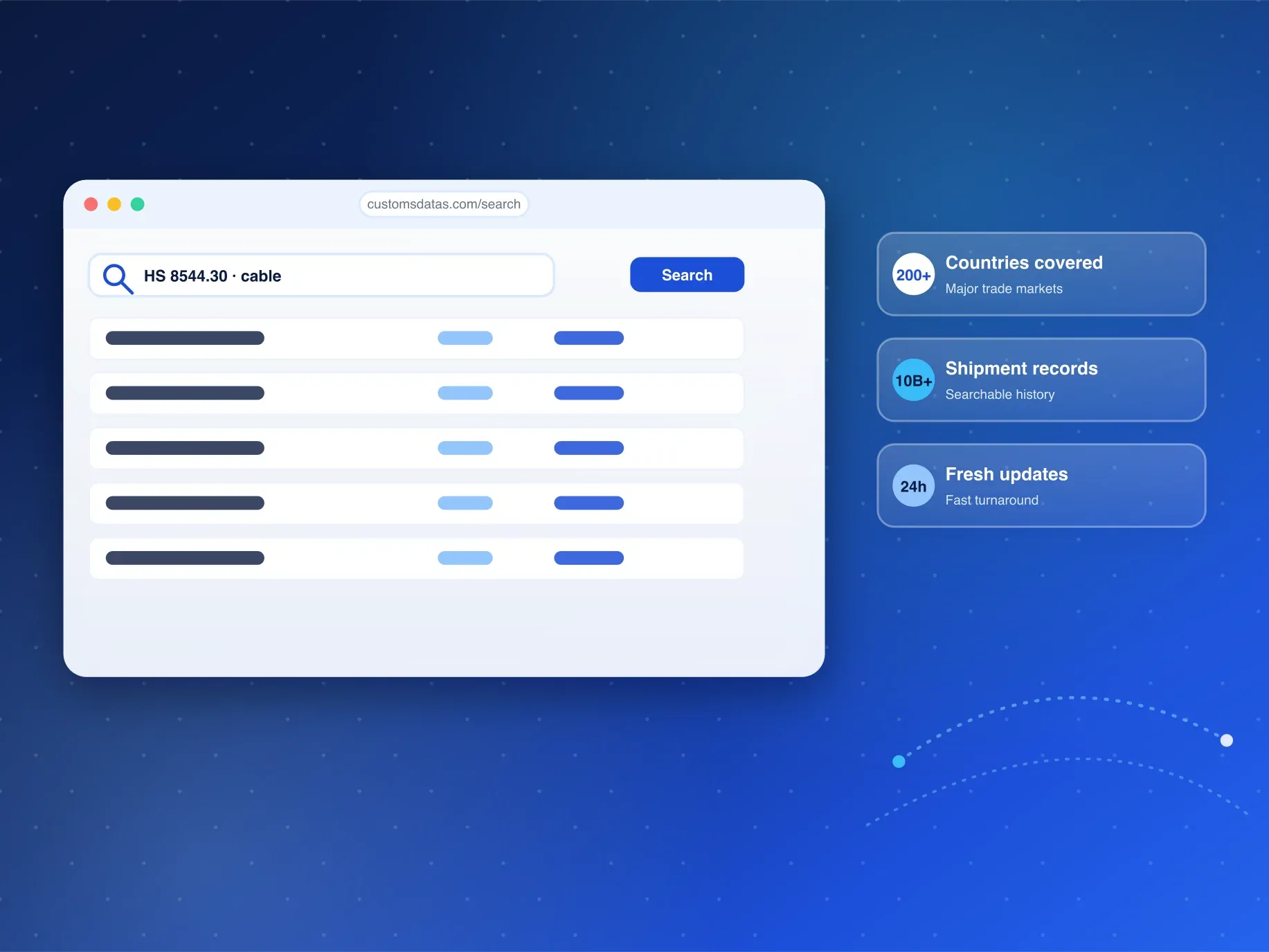
A beginner question that appears in every trade forum: what can you actually search for in customs data? The honest answer has more structure than people expect. Trade records answer along five dimensions — product, company, direction, geography and time — and most disappointing first searches share one cause: they used one dimension when the question needed two or three combined.
This guide walks the five dimensions in plain terms, then shows how combining them turns a records search from a lookup into an analysis. Field names vary by market and are confirmed on a sample run; the dimensions themselves do not.
Dimension one: the product
Product is where everyone starts — a description keyword or the HS code the goods move under. It is the right start, and it has a subtlety the beginners' guides cover well: codes classify more precisely than words, and one product often spans several codes. Search the product, then widen to the codes it actually travels under.
Buyer tip: keep a written list of the codes your category uses. It becomes the backbone that every other dimension attaches to.
A note on choosing between the two product handles: wording reaches what codes miss — newer products, marketing names, wording that predates a code revision — while codes reach what wording scatters. Running both and keeping the union of results is the honest version of a product search.
Dimension two: the company
Company search runs in two directions. Forward: pick a company and see its trade history — what it buys or ships, how often, how it is trending. Backward: pick a product and see which companies move it. The first is how you check a specific prospect or monitor a competitor; the second is how you build a list from scratch. Both use the same records; the difference is which side you start from.
The company dimension also carries the monitoring use: a company searched on a schedule becomes a tracked account, and tracked accounts are how a file turns into early warnings — a new category appearing under a familiar name is often the earliest public sign that a business is moving into your space.
Third axis: which way the goods move
Every movement is an import or an export, and the direction decides whose story a record tells: the buying side reveals demand, the selling side reveals supply. Searching both for one category is how you tell a manufacturing economy from a consuming one — and how you notice when a country plays both roles in the same product family.
Direction also doubles as a quality check on the other dimensions. A party listed as a buyer on the import side and a seller on the export side of the same goods family is trading, not consuming — and reading direction first prevents the most common beginner error: treating every name in the file as a customer.
Dimension four: the geography
Geography enters twice: the country whose records you are reading, and — where the records carry it — the counterpart country on the other side of each movement. The second is the underrated one: it shows where a market's supply comes from or where its goods go, which is how you find the markets connected to the market you started with.
Counterpart geography has one more use worth naming: it separates local players from global ones. A market supplied mostly from one neighbouring country behaves differently from one supplied from five continents — different price logic, different logistics assumptions, different openings for a new supplier — and all of that is readable before you contact anyone.
The fifth axis: the window you choose
Time is the dimension that turns the other four from snapshots into analysis. The same search over different windows answers different questions: one month shows current movement, a year shows rhythm, three years show trend. Most misreads come from letting the window default instead of choosing it to fit the question.
Buyer tip: fix the window before you search and write it down next to the results. An unnamed window is how two people run the same search and argue about different answers.
Windows interact with the other dimensions too. Recency matters most for the company dimension (is this account still alive), length matters most for the product dimension (does the category have a track record), and comparison windows matter most for geography (which supply sources are gaining). Choosing the window per dimension, rather than one default for all, is what makes a five-dimension search feel designed.
Where the dimensions combine, the question appears
The five dimensions earn their keep in combination. Product plus company answers what a specific business actually trades. Product plus direction plus geography maps who supplies a market. Product plus company plus time reveals whether a relationship is growing. Each added dimension narrows the result set — which is the point: the search converges on the question you actually have.
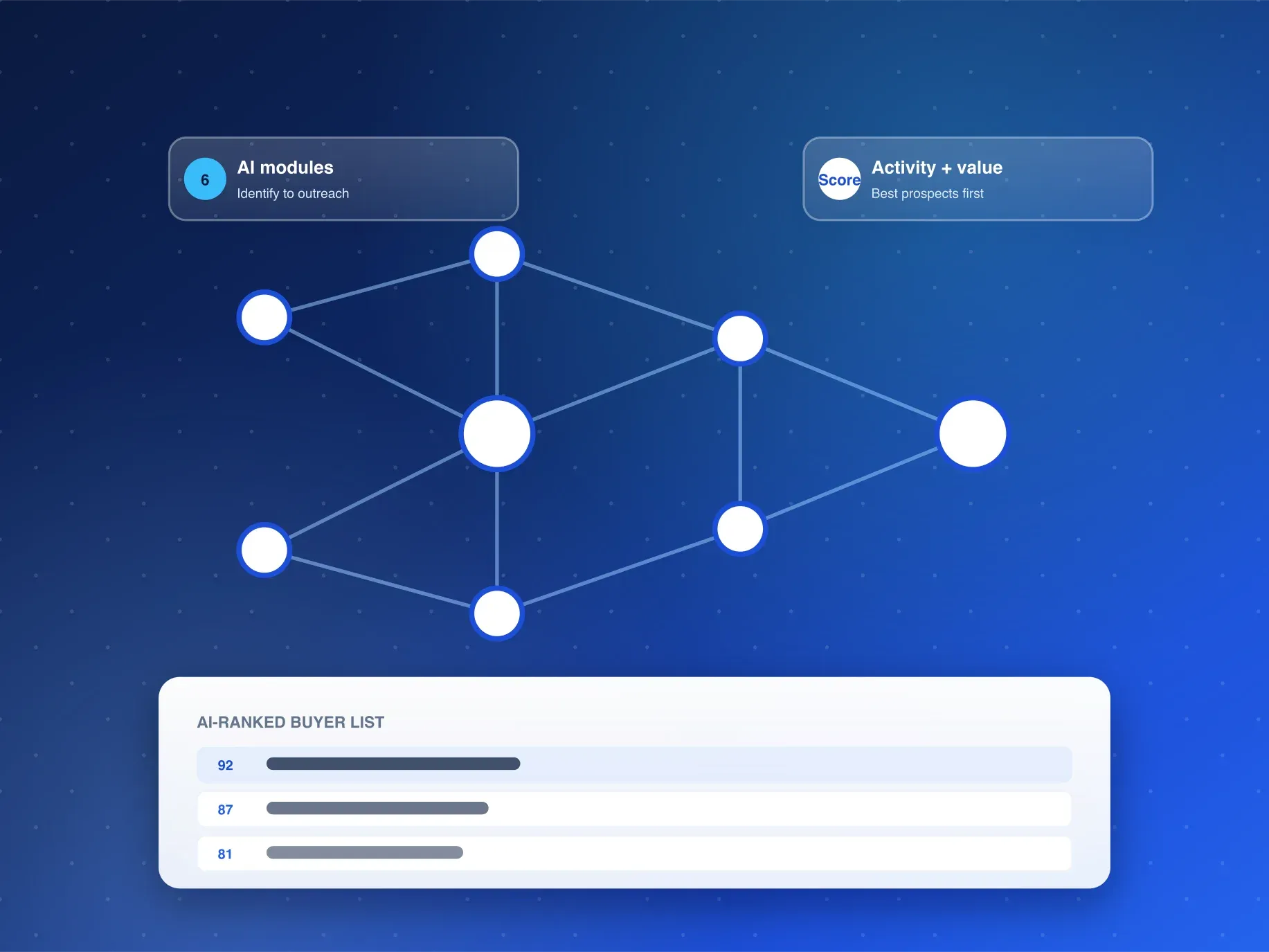
The workflow on Customsdatas follows exactly this logic: pick the market, combine the dimensions that match your question, and read the results at the grain you need. From there the six modules of the AI Buyer Discovery Suite take over — identification, activity and opportunity value, market recommendation, similar-buyer discovery, outreach lists with emails and WhatsApp contacts, and competitor buyer detection — the scoring and contact pass running over what your dimensional search surfaced.
A closing orientation for beginners: the dimensions are not a checklist to complete but a grammar to speak. Questions arrive in your own words — who supplies this market, where does my competitor buy, is this category growing — and the five dimensions are how those words translate into searches the records can answer. Fluency comes fast, usually within the first sample.
Frequently Asked Questions
Which dimension should a first search use?
Product — a description or a code — plus a chosen window. That pair answers whether the category moves in the market at all, and everything else builds on it.
Do all five dimensions exist in every market?
The dimensions describe how the records can be read; which fields ship with each market's records, and how finely they are populated, is confirmed on a sample run for that market.
How do I try a five-dimension search on my product?
Ask through the inquiry form or WhatsApp; within 24 hours (Mon-Sat, GMT+8) a reply comes back with records you can read along all five dimensions — name your product line in the message.
One dimension tells you what moved. Five tell you what to do next — request a free sample from Customsdatas and search all five within 24 hours.