Sep 28, 2026Country Guides
Angola Customs Data (2026): Testing an Assumption Before You Build a List
Angola's coverage pairs a trade layer with a statistics layer under a NEW flag. The fastest way to use both: write a checkable assumption first, then let each layer confirm or kill it.
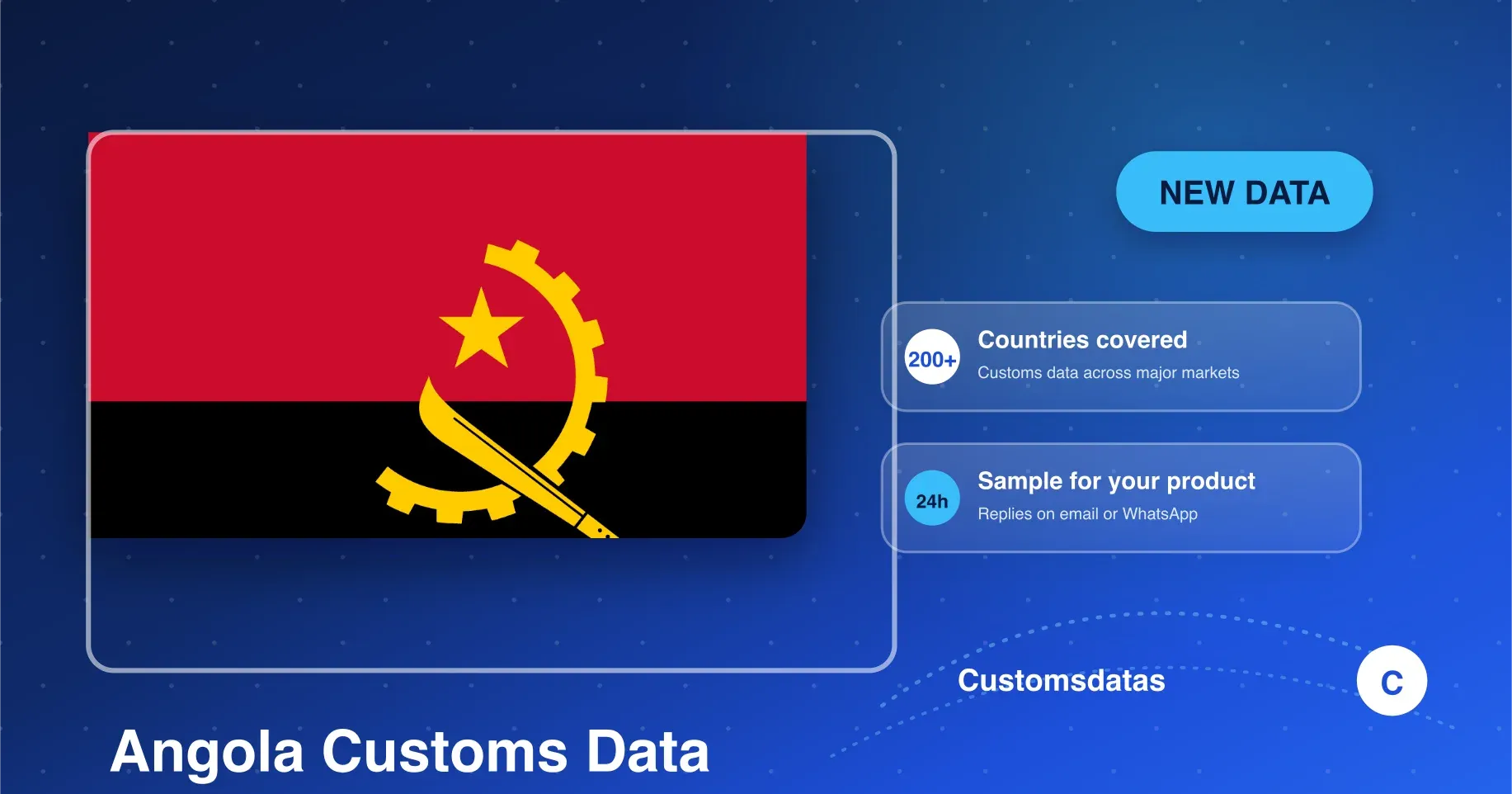
Angola arrives on Customsdatas with two layers — a trade layer and a statistics layer — under a NEW flag. Two layers invite a tempting shortcut: skim both, keep whatever flatters the product, and call the result a market read. That shortcut produces confident briefs that fall apart on the first reply. The slower alternative costs fifteen extra minutes and holds up much better: state an assumption you can check, then let each layer test it on its own terms.
This guide sets out that method — what an assumption needs before it is worth testing, what each layer contributes to the test, and what a disagreement between the two actually means for your next move.
Why an assumption beats a search
A search returns whatever the file happens to contain on the day you run it. An assumption forces you to say, in advance, what you expect to find and at roughly what scale. The difference matters most in a market whose coverage is new, where the file is still filling in and a thin result may say more about the coverage than about the market.
Buyer tip: write the assumption in a form that can fail. Angolan buyers take mid-size lots of this category on a repeat cadence is checkable. Angola needs my product is not, and no search will ever prove it wrong.
Writing the assumption so it can fail
Three components make an assumption testable: a subject (which buying pattern you expect), a scale band (what counts as present), and a time window (how recent it must be). Miss any one and the check dissolves into opinion. With all three, a search either surfaces the pattern or it does not, and either outcome is information you can use.
Keep the first assumption small and specific — one category, one direction, one cadence band. Testing a single pattern takes an afternoon; testing the market takes a quarter and ends with a document nobody trusts.
Buyer tip: tape the dated assumption to the top of the working file. When the numbers arrive, that note is what stops you from quietly moving the goalposts to fit the result.
First test: does the aggregate agree on size
The statistics layer answers a sizing question: at aggregate level, is this category large enough in Angola to carry a campaign at all? This is a coarse test on purpose. It is meant to eliminate categories cheaply — the ones that read as rounding errors in the aggregate — before any work goes into them.
Read the aggregate as a band rather than a figure. A category that sits comfortably inside the band your assumption named passes this test; one that falls below it fails, and failing cheaply is exactly what the first test is for.
Second test: does the flow show a cadence
The trade layer answers a harder question: does the category show movement — repeated across periods, present across more than one party, recent enough to act on? A cadence is the test the campaign actually depends on, because a category can be large in aggregate and still show almost no readable activity at declaration level.
Read the flow for rhythm rather than totals. Two parties moving steadily across the window say more about live demand than one large movement that appears once and stops.
When the two tests disagree
An encouraging aggregate with a quiet flow usually means you are early: the category is real, but either the activity or the coverage is still thin. A busy flow inside a small aggregate is the rarer split, and it deserves care — in a new coverage, the aggregate can lag the declarations for a period before the two settle into agreement.
Either way, the split is a finding to record, not a contradiction to resolve by preference. Write down which side said what, and revisit the same question on the next refresh instead of forcing a verdict today.
Why a failed check can wait a quarter
Angola carries a NEW flag, and new coverage bends the method in a predictable direction: the file improves over time. An assumption that fails against today's file may pass next quarter without anything about the market having changed. That is a reason to keep the assumption and re-run it, not to rewrite the assumption until the current file agrees.
The practical habit is a dated result sheet per run. Three months from now, the movement between two dated sheets will tell you more about the market than either sheet alone, because the comparison strips out the noise that any single read carries.
The fifteen-minute sample read
What either Angolan layer can answer, and how fresh the window is, are both settled on a sample run against current data. A catalogue of what a market can carry is not the same as the file in front of you, so read a live sample before you commit search terms.
Treat the check as a short step, not a research project: request the sample, read it against the assumption you wrote, then commit your search terms to what the file can really answer.
Frequently Asked Questions
What does Angola's coverage include right now?
Angola's coverage on Customsdatas carries a trade layer and a statistics layer, both under a NEW flag. The wider platform spans 200+ countries and 10B+ records, with 50M+ buyers drawn from 260M+ companies; six AI tools work across the set. What each Angolan layer carries today is confirmed on a sample run.
Why write an assumption instead of searching directly?
A direct search returns whatever the file holds; the assumption tells you whether that result means anything. In new coverage, that difference decides between a finding and a coincidence.
How do I test an assumption on Angolan data?
Send a short request through the inquiry form or WhatsApp, and a reply with Angola records matched to your product line comes inside 24 hours (Mon-Sat, GMT+8).
Want to run your first assumption against Angola's two layers? Request a free sample from Customsdatas and have the test data within 24 hours.